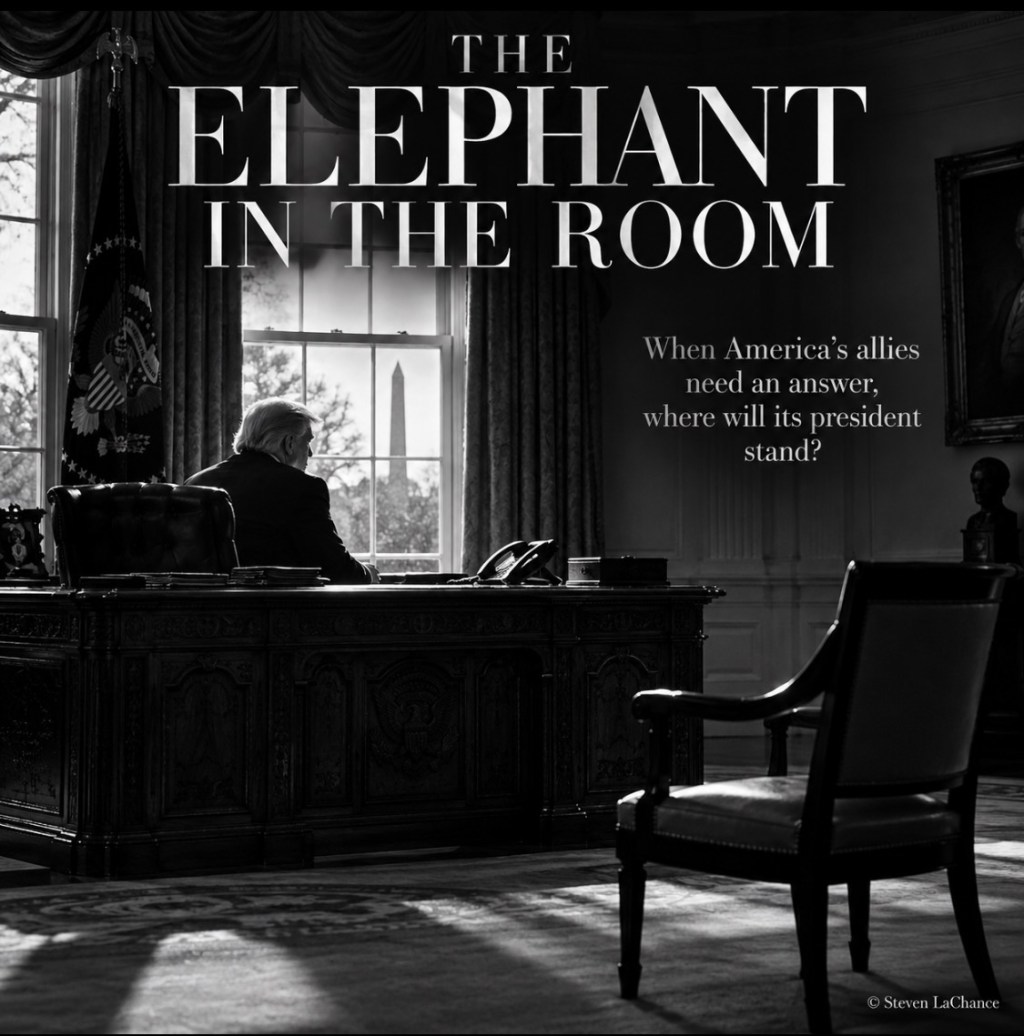
We need to talk about the elephant in the room, and that elephant is Donald Trump.
For months now, it seems that every morning we wake up to a world a little less stable than the one we went to sleep in. Another crisis, another threat, another reminder that the international order we have depended upon for generations is becoming dangerously fragile.
Is Europe on the brink of war? It certainly feels that way. In an October 17 article published by the Financial Times, Gideon Rachman asks whether we are sleepwalking into World War III. Those are frightening words, but given what is happening around the world, they deserve serious consideration.
This morning, Ukraine is once again dealing with the aftermath of devastating Russian attacks. Civilian lives have been lost, energy infrastructure has been damaged, and hundreds of thousands of people are facing blackouts. Meanwhile, Vladimir Putin reportedly wants a summit with Donald Trump and Chinese President Xi Jinping to discuss ending the war in Ukraine. The extraordinary part? There is no indication that Ukraine would even be invited to the table.
Think about that. Three powerful nations potentially discussing the future of a country that Russia invaded, without that country’s participation. The summit has not been agreed upon, but the proposal itself tells us something about how Putin believes the world should operate.
And while Russia continues attacking Ukraine, Donald Trump has decided to waive sanctions intended to put economic pressure on Moscow. His administration argues that doing so serves American interests and preserves the possibility of diplomatic negotiations. But what exactly has Putin offered in return?
Congress overwhelmingly supported these sanctions. The Senate passed the legislation by a vote of 86 to 11. This was not some Democratic attempt to embarrass a Republican president. It was an overwhelming bipartisan decision to hold Russia accountable for its aggression.
Trump signed that legislation into law and then used its waiver provisions to suspend the very economic pressure Congress intended to impose.
Now members of his own party are openly challenging him.
Republican Senator Thom Tillis has condemned the administration’s approach. Republican Senator John Cornyn has called helping Putin reckless and circulated a National Review column urging Congress to investigate whether Trump’s actions are providing aid and comfort to Vladimir Putin. Democrats are raising equally serious objections, and lawmakers from both parties are discussing ways to challenge the president’s decision.
Consider what that means.
A Republican president is facing public criticism from Republican lawmakers who believe his decisions are weakening American national security and strengthening one of America’s principal adversaries. They are not arguing over a domestic spending bill or another routine policy disagreement. They are questioning the direction of American foreign policy while a major war continues in Europe.
And the language being used is extraordinary.
We are now hearing the constitutional phrase “aid and comfort” in discussions about a sitting American president. That does not automatically establish the legal crime of treason, which has a very specific constitutional definition. But when serious conservative legal commentators are raising questions about the president’s assistance to Putin, and Republican lawmakers are circulating those arguments, we have moved into profoundly troubling territory.
I want to be very clear about something. This is no longer simply Democrats criticizing Donald Trump. There is a documented bipartisan confrontation developing over whether the president’s decisions are serving American national security or undermining it.
Our constitutional system of checks and balances is supposed to address situations like this. Congress has the authority to investigate, legislate, and demand accountability. The president has foreign policy powers, but those powers do not place him beyond scrutiny. Even when a waiver is legally authorized, its use can be challenged on the merits.
The problem is that congressional objections mean very little if they never translate into meaningful action. And with Congress currently in recess, the possibility of an immediate legislative response is limited.
Meanwhile, Europe is watching.
Governments that have relied on American leadership and security commitments for generations are being forced to confront an increasingly uncomfortable possibility. What happens if the United States can no longer be counted on to stand firmly beside its allies? What happens if Vladimir Putin concludes that Washington is more interested in negotiating with him than in confronting the aggression that brought Europe to this point?
History has taught us the consequences of miscalculating an aggressor’s ambitions. Deterrence depends on credibility, and credibility is difficult to maintain when your friends no longer know where you stand and your adversaries begin to believe they can dictate the terms.
Donald Trump is entitled to pursue diplomacy. He is not entitled to freedom from congressional oversight, public accountability, or questions about whether his decisions serve American interests.
And those questions are becoming increasingly difficult to avoid.
What exactly is the United States receiving in return for weakening economic pressure on Vladimir Putin? Why is the president offering concessions while Russia continues attacking Ukrainian cities? And why should Americans believe that reducing pressure on Moscow will produce peace when Putin has yet to demonstrate that he is prepared to end his aggression on terms Ukraine can accept?
These are not unreasonable questions. They are questions the president should be required to answer.
I have spent much of my life following American politics. I understand political disagreements, partisan battles, and the extraordinary pressures of the presidency. But this is different. We are witnessing a confrontation over the direction of American foreign policy at a time when the international order itself is under enormous strain.
And I find it especially disturbing that the confrontation now includes members of the president’s own political party.
Nobody knows whether Europe is approaching another major war. I sincerely hope it isn’t. But hope is not a foreign policy, and diplomacy without meaningful leverage can become little more than an invitation for an aggressor to demand more.
The elephant in the room is no longer simply Donald Trump’s relationship with Vladimir Putin. It is whether the president of the United States is making decisions that strengthen our adversaries, weaken our allies, and leave our constitutional institutions struggling to hold him accountable.
The American people deserve answers. Congress has a responsibility to demand them. And Donald Trump has an obligation to explain whose interests his foreign policy is actually serving.
Because one question now hangs over everything else.
If Europe finds itself at war with Russia tomorrow, will Donald Trump stand beside our allies, or will they discover that America has left them standing alone?


Leave a Reply