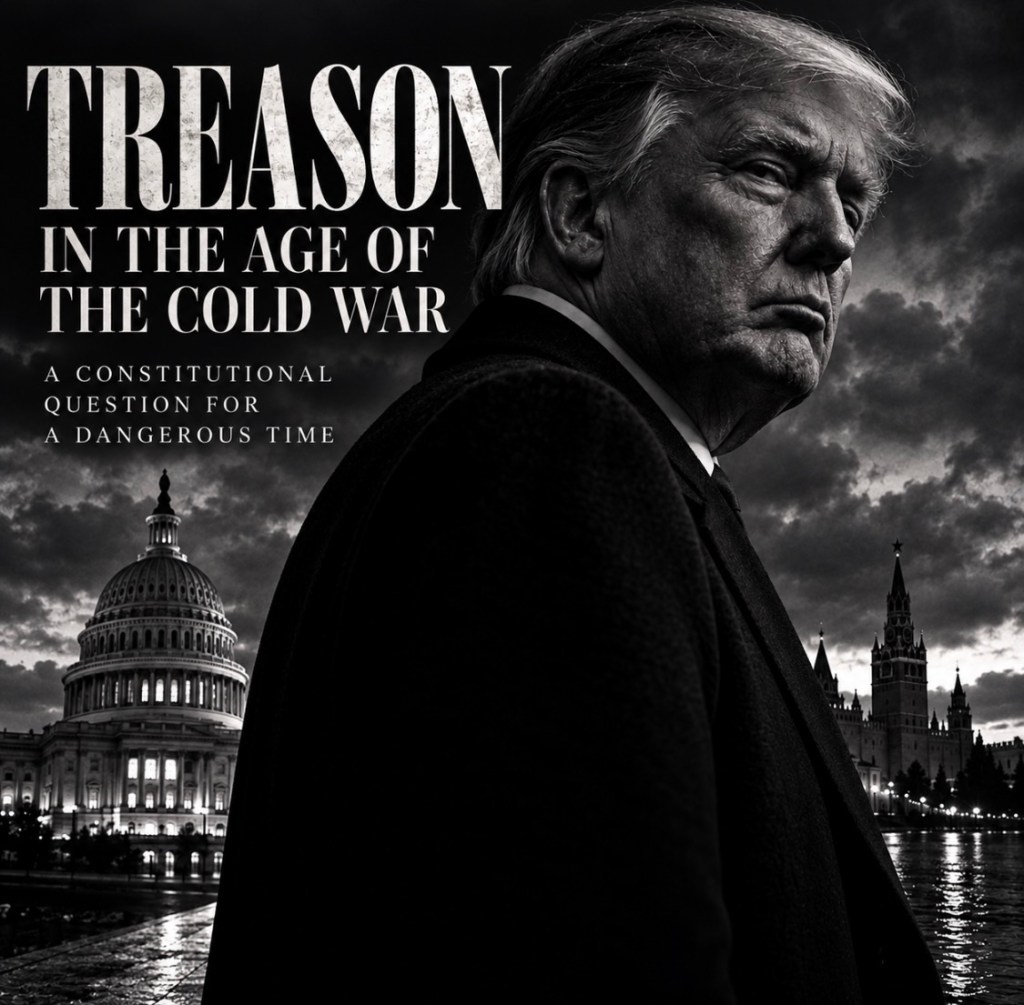
I’ve been seeing something lately that I don’t remember seeing quite so frequently before. Americans are calling the president of the United States a traitor. Not simply a liar, a criminal, or a corrupt politician. A traitor.
That’s a serious word. It’s one of the most serious accusations an American can make against another American, particularly when that person happens to occupy the Oval Office.
Now, I understand there are two ways to define treason. There’s the moral definition, which involves betraying one’s country, its people, and the principles upon which it was founded. And then there’s the legal definition, specifically outlined in Article III, Section 3 of the United States Constitution.
I believe Donald Trump has crossed the moral line. I have watched his conduct, his treatment of America’s allies, his relationship with Vladimir Putin, and his willingness to place extraordinary pressure on nations defending themselves against Russian aggression. In my judgment, this is a president who has repeatedly betrayed the responsibilities entrusted to him.
But I also believe we need to examine just how close his actions might come to crossing the constitutional line.
And that brings me to a question I’ve been thinking about.
Who decided that a war must be formally declared before an enemy can be considered an enemy?
We spent nearly half a century engaged in something called the Cold War. Nobody questioned whether it was a war in the political and historical sense. There were spies, assassinations, proxy conflicts, nuclear threats, economic warfare, and intelligence operations conducted around the world. Nations were destabilized. Governments fell. People died.
Yet the United States and the Soviet Union never formally declared war against one another.
Today, warfare has evolved even further. Foreign governments can attack a nation’s infrastructure, penetrate its computer systems, interfere in its democratic institutions, and conduct intelligence operations without sending a single soldier across its borders.
A country can sustain devastating attacks without ever hearing the traditional sounds of warfare.
So, when we discuss treason in the twenty-first century, shouldn’t we at least examine what constitutes an enemy?
The Constitution defines treason as levying war against the United States or adhering to its enemies, giving them aid and comfort.
Notice something important. The Constitution does not explicitly say that Congress must first issue a declaration of war.
Now, that doesn’t mean every hostile foreign government automatically qualifies as an enemy under the Treason Clause. American courts have historically interpreted the constitutional crime narrowly, and the Cold War was not legally equivalent to an armed conflict between the United States and the Soviet Union.
But is that the end of the discussion?
In Hamdi v. Rumsfeld in 2004, Justice Antonin Scalia, joined by Justice John Paul Stevens, discussed the historical legal treatment of citizens who wage war against their country. Their dissent examined the constitutional importance of treason prosecutions and historical understandings of wartime allegiance.
That dissent did not establish that the Cold War satisfies the constitutional definition of war. Nor has the Supreme Court ruled that sustained cyberwarfare, foreign intelligence operations, or election interference automatically make another nation an enemy for purposes of Article III.
But those limitations leave us with a constitutional question worth examining.
Are we interpreting an eighteenth-century provision in a manner that adequately recognizes twenty-first-century warfare?
Because if our understanding of national betrayal depends exclusively on conventional armies and formally declared wars, what happens when some of the most dangerous attacks against a nation are carried out through intelligence networks, computer systems, financial transactions, and political manipulation?
Must we wait until missiles begin falling before we recognize that a foreign power is conducting hostile operations against our country?
Now let’s consider Russia.
Russia has conducted intelligence operations against the United States, interfered in American elections, and engaged in hostile cyber activity. These are not merely theoretical concerns. American intelligence agencies and bipartisan congressional investigations have documented Russian operations targeting American democratic institutions.
And Russia continues its war against Ukraine.
Yet Donald Trump’s administration has taken a series of decisions that deserve extraordinary scrutiny.
In October 2026, Trump announced an arrangement involving more than 300,000 metric tons of Russian diesel in an initial shipment, with the prospect of additional deliveries. The administration presented the agreement as a means of addressing high fuel prices and encouraging Moscow to negotiate.
But the arrangement also created a commercial opportunity for Russia while Putin continued his assault on Ukraine.
The Kremlin welcomed the prospect of expanded economic cooperation. Russian officials openly discussed opportunities for additional trade and investment.
Then came another development.
Trump moved to delay major new sanctions against Russia, despite overwhelming bipartisan congressional support for the legislation. His administration invoked a national-interest waiver authorized under the law.
That last point matters. Congress had provided a mechanism allowing the president to waive certain sanctions. The exercise of that authority was not, by itself, proof of illegality.
But legal authority and moral responsibility are two different things.
Congress had acted to increase economic pressure on Russia. Trump instead exercised his authority to postpone that pressure while pursuing an energy arrangement with Moscow.
Members of both parties objected. Republican and Democratic senators publicly urged the administration to reverse course. Ukrainian President Volodymyr Zelenskyy warned that weakening sanctions would benefit Russia and embolden Putin.
Meanwhile, Trump criticized Ukrainian attacks against Russian energy infrastructure while Russia continued striking Ukrainian targets.
I find this morally indefensible.
A country defending itself against invasion is being pressured to restrain its ability to strike the aggressor’s economic infrastructure, while the American president pursues arrangements that could provide that aggressor with additional revenue.
And we’re supposed to believe there is nothing here worth investigating?
I want to know who profits from these arrangements. I want to know whether anyone close to the president has financial interests connected to the negotiations. I want to know precisely what concessions Russia offered, what concessions America made, and whether the administration adequately assessed the national security consequences.
Those are questions, not claims that secret payments or corrupt arrangements have already been established.
But they are questions the American people have every right to demand answers to.
The president’s defenders argue that diplomacy with adversaries is necessary, that lowering energy prices serves American interests, and that economic incentives might help bring Putin to the negotiating table.
Fine. Those arguments deserve examination.
But diplomacy is not a magic word that makes every decision wise, every concession defensible, or every potential conflict of interest disappear.
Nor does the president’s constitutional authority over foreign policy mean that his decisions should escape investigation.
Which brings me to the Supreme Court.
On July 1, 2024, the Court issued its ruling in Trump v. United States, establishing criminal immunity for certain presidential actions.
The Court held that a former president enjoys absolute immunity for conduct within his exclusive constitutional authority, presumptive immunity for other official acts, and no immunity for unofficial conduct.
It did not declare that presidents can commit any crime they please.
But it created a deeply troubling constitutional problem.
What happens when the very powers entrusted to a president for the protection of the United States are allegedly used to betray it?
Consider the implications.
Negotiating with foreign governments, conducting diplomacy, directing national security policy, and exercising executive authority are central presidential responsibilities.
Suppose a president deliberately used those powers to benefit a hostile foreign government at the expense of the United States. Suppose investigators uncovered evidence suggesting that decisions presented as legitimate diplomacy were actually intended to assist that foreign power.
Could prosecutors investigate the president’s intentions? Could they present evidence of his official conduct? Could the president argue that the very actions constituting the alleged betrayal were protected by presidential immunity?
Under the Court’s 2024 ruling, these would become difficult constitutional questions.
The majority instructed courts not to examine presidential motives when classifying conduct as official or unofficial. It also restricted prosecutors’ ability to introduce evidence of protected official acts when pursuing charges based on unofficial conduct.
That restriction does not mean prosecutors can never prove criminal intent. But it can limit the evidence available to establish certain crimes.
And treason is a crime in which intent matters enormously.
In Cramer v. United States in 1945 and Haupt v. United States in 1947, the Supreme Court examined the strict constitutional requirements for treason. It is not enough for an individual’s actions to benefit an enemy. Prosecutors must establish adherence to the enemy, an overt act providing aid and comfort, and the necessary intent to betray the United States.
The framers deliberately made treason difficult to prosecute. They understood the danger of allowing political leaders to manufacture accusations against their opponents.
That protection is essential.
But now consider the other side of the problem.
If proving treason requires demonstrating an intention to betray the United States, while presidential immunity can restrict the use of evidence concerning official conduct, have we created a constitutional framework in which some of the most consequential abuses of presidential power could become extraordinarily difficult to prosecute?
Justice Sonia Sotomayor warned about the dangers of the immunity ruling in her dissent. She believed the majority had created protections that threatened the principle that no person, including the president, stands above the law.
That concern deserves to be taken seriously.
And there is another constitutional safeguard worth examining.
Article III requires testimony from two witnesses to the same overt act of treason, or a confession in open court.
Now, consider what happens when the alleged act is conducted openly, in the presence of elected representatives and the American public.
We live in an age in which presidential actions are announced before cameras, recorded, transcribed, published, and examined around the world. A president can issue an executive order, announce an agreement, or make a foreign policy declaration while millions of people watch.
The framers required witnesses to protect Americans against fabricated accusations of treason.
They did not require those witnesses to belong to the same political party, hold a particular office, or agree about the accused person’s motives.
Could two members of Congress, one Republican and one Democrat, testify to the same presidential action? Of course they could, provided they personally witnessed it and their testimony satisfied the constitutional requirements.
In Haupt v. United States, the Supreme Court explained that the intention behind an overt act can be established through evidence beyond the testimony of those two witnesses.
That doesn’t mean the public witnessing an announcement automatically satisfies the constitutional requirement. Nor does it mean every public presidential action constitutes an overt act of treason. The action must be legally sufficient, and the remaining elements of the offense must still be proved.
But it raises an interesting question.
When a president’s actions are conducted in full public view, is the greatest obstacle proving what he did, or proving that he did it with the intention of betraying his country?
And that brings me to Congress itself.
We sometimes speak of Congress as though it were merely another political institution competing with the president for power.
But Congress represents the American people.
Its members are elected to act on behalf of the people who sent them to Washington. And when they take office, they swear an oath that deserves more attention than it sometimes receives.
Under 5 U.S.C. § 3331, members of Congress pledge to support and defend the Constitution of the United States against all enemies, foreign and domestic, and to bear true faith and allegiance to that Constitution.
Read those words carefully.
Their oath is not to Donald Trump. It is not to the Republican Party or the Democratic Party. It is not to a political movement, a donor, or a personal benefactor.
Their oath is to the Constitution.
And through the constitutional system of representative government, they exercise responsibilities entrusted to them by the American people.
In that representative sense, they stand in Congress for the people who elected them.
Now, their oath does not magically turn them into legal witnesses to actions they never observed. Nor can political representation substitute for the specific evidentiary requirements of Article III.
But that doesn’t diminish the importance of their constitutional responsibility.
If two members of Congress, one Republican and one Democrat, directly witness the same potentially treasonous act, they can provide testimony like any other qualified witnesses. Their oath independently obligates them to uphold the Constitution and faithfully discharge their duties.
And if credible evidence of betrayal emerges, members of Congress have constitutional mechanisms available to investigate misconduct, demand testimony, examine executive actions, and pursue impeachment when justified.
Article II, Section 4 specifically names treason among the grounds for presidential impeachment and removal.
Think about that.
The Constitution explicitly recognizes treason as grounds for removing a president. Congress is given a central role in that process. And the members responsible for exercising that authority have sworn to defend the Constitution against foreign and domestic enemies.
Surely the framers did not intend for those responsibilities to become meaningless whenever the alleged misconduct involved someone powerful enough to command political loyalty.
And surely an oath to defend the Constitution does not become optional because the president belongs to your political party.
This is where I believe the moral and constitutional questions begin to intersect.
Donald Trump has the authority to negotiate with Russia. He has the authority to conduct diplomacy. He possesses substantial powers over American foreign policy.
But those powers are entrusted to him for the benefit of the United States.
They are not personal possessions.
They are not instruments for enriching friends or rewarding political allies.
And they should never become a means of placing the interests of a hostile foreign power above the interests of the American people.
I am not arguing that Donald Trump has been legally proven guilty of treason. He has not.
Nor am I arguing that every policy benefiting Russia constitutes a criminal act. American presidents must be able to conduct diplomacy, negotiate with adversaries, and make difficult decisions without automatically facing criminal prosecution.
But I refuse to accept the idea that presidential decisions are beyond serious scrutiny simply because they involve foreign policy.
And I reject the notion that we must wait until irreparable damage has occurred before we begin asking whether the actions of our leaders amount to betrayal.
To me, Donald Trump’s repeated willingness to accommodate Putin, weaken pressure on Russia, and place extraordinary burdens on Ukraine represents a profound moral failure of presidential leadership.
That is my judgment, and I stand by it.
Whether his conduct could ever satisfy the legal definition of treason is a separate question requiring evidence, judicial interpretation, and a standard of proof that must never be compromised for political convenience.
But that question should not be dismissed simply because the constitutional language was written in 1787.
The world has changed. Warfare has changed. The means by which foreign governments can damage the United States have changed.
And now the Supreme Court has changed the rules governing presidential criminal accountability.
We need to examine how those changes intersect.
Because the question is no longer simply whether a president can betray his country.
It is whether our constitutional system can recognize and hold accountable a presidential betrayal carried out through the powers of the presidency itself.
Congress represents the people. Its members have sworn to defend the Constitution. The courts are entrusted with interpreting that Constitution. And the president has sworn to preserve, protect, and defend it.
None of those obligations disappears because the person whose conduct is being questioned occupies the Oval Office.
And I don’t believe the American people should have to discover the limits of those obligations after the damage has already been done.


Leave a Reply