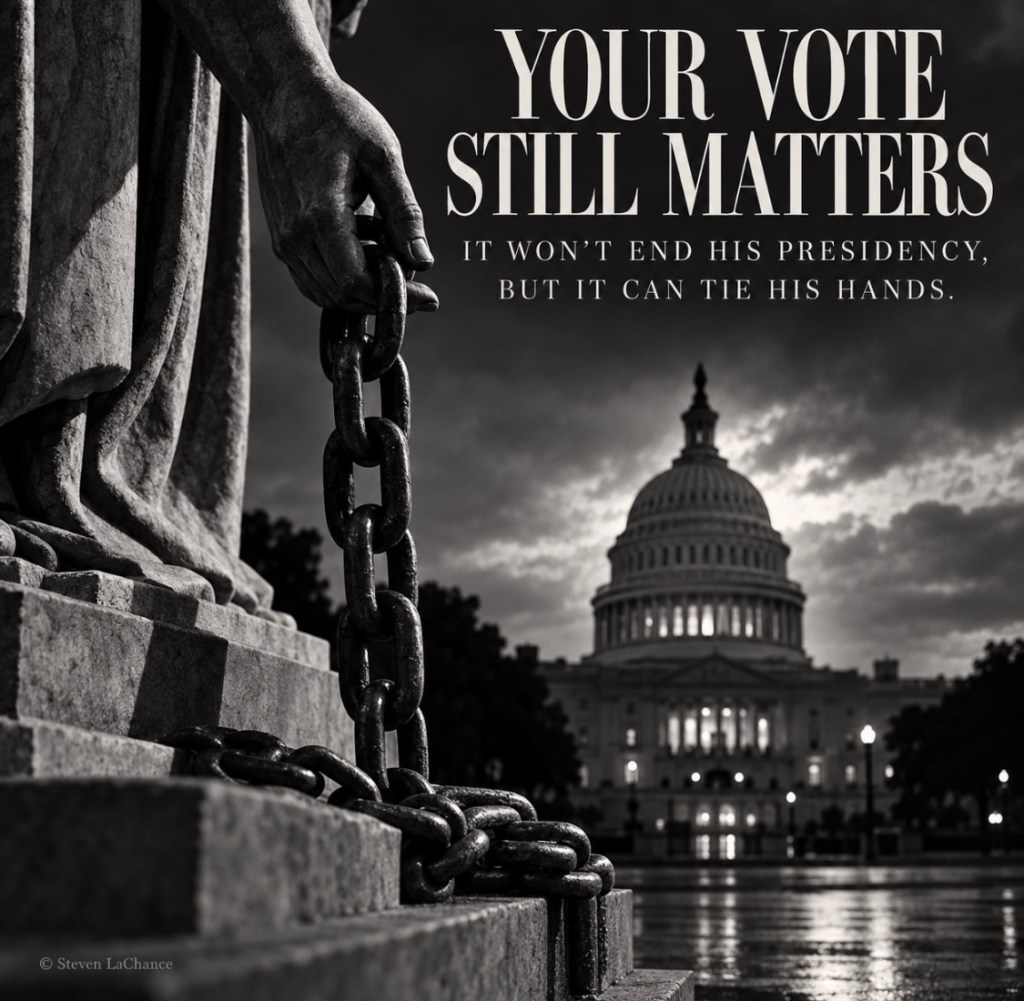
A little government and history lesson before November.
With the midterm elections approaching, I’ve been hearing a lot of discussion about what Donald Trump might do if Republicans suffer major losses. But I think there’s a more important question. What happens when a president loses the confidence of most Americans but still holds the powers of the presidency?
Let’s have a little American government refresher for those of us who were looking out the window during history class. Lol.
According to recent polling, Trump’s approval rating has fallen to around 30%, with nearly 70% of Americans disapproving of his performance. Even some of the people who voted for him in 2024 are turning away. This isn’t simply Democrats versus Republicans anymore. Dissatisfaction with this president extends well beyond party lines.
Now, suppose Democrats win control of both the House and Senate in November. Does that mean Trump’s presidency is over?
No. But it could tie his hands considerably.
Donald Trump would remain president until January 2029 unless he leaves office earlier. He would retain his constitutional powers, including his authority over the executive branch and his ability to veto legislation.
However, Congress makes federal laws, controls federal spending, and has the authority to investigate the executive branch. A Democratic Congress could block much of Trump’s legislative agenda, scrutinize his administration, challenge spending priorities, and demand accountability.
But there’s a catch. Trump could veto legislation passed by Congress, and overriding that veto requires a two-thirds vote in both chambers. In the Senate, most legislation also faces a 60-vote hurdle under existing rules.
In other words, neither side could easily accomplish everything it wanted without cooperation. That’s called divided government, and we’ve experienced it many times throughout American history.
But there’s another factor that could change the political landscape considerably. The Republican Party itself.
Politicians have a remarkable instinct for political survival. When a president is popular, members of his party are eager to stand beside him. When that president becomes a political liability, loyalties can change.
We’re already seeing Republican candidates distancing themselves from Trump on certain issues. As his approval ratings decline, the question becomes how much influence he can maintain over members of his own party, particularly if they suffer substantial losses in November.
History offers an interesting lesson here.
Richard Nixon didn’t resign simply because Democrats opposed him. As the Watergate evidence mounted, Republican leaders began withdrawing their support. Eventually, Nixon was told he lacked the congressional support necessary to survive impeachment proceedings.
I’m not suggesting Trump will follow the same path. The circumstances are different. But Nixon’s experience demonstrates something important. A president’s political power depends on more than the Constitution. It also depends on whether other elected officials are willing to support him.
Imagine a Democratic Congress with a growing number of Republicans willing to challenge Trump. Congressional investigations could gain bipartisan support. Legislation might attract unexpected allies. His political influence could diminish even while his constitutional authority remained intact.
Of course, that doesn’t mean gridlock would disappear. Healthcare, immigration, the economy, and federal spending would still require negotiations and compromise. Even impeachment would not automatically remove Trump. Conviction requires a two-thirds vote in the Senate.
And remember, the newly elected Congress would not take office until January 3, 2027. The current Congress would continue conducting business until then.
So what does all this mean for your vote?
It means your vote in November is considerably more important than some people seem to realize.
Think about it. Politicians are traveling across the country, flooding television and social media with advertising, and spending billions of dollars trying to win these congressional elections. They’re not doing that because Congress is unimportant. They’re doing it because control of Congress determines who writes legislation, who controls congressional investigations, who influences federal spending, and how much freedom a president has to advance his agenda.
The political parties understand exactly how much power is at stake. Voters should understand it, too.
A president may remain in office regardless of the midterm results, but the Congress elected by the American people can significantly change what that president is able to accomplish.
And that’s the beauty of our constitutional system. The founders deliberately divided power so that no single person or political party could exercise unlimited authority. Congress was never intended to be a rubber stamp for the president.
The next two years could certainly bring political confrontation and gridlock. But they could also demonstrate just how important those constitutional checks and balances really are.
Your vote doesn’t just determine who represents you in Congress. It helps determine how much power the president can exercise through the legislative process.
And if you ever wonder whether your vote really matters, just look at how much time, energy, and money politicians are spending trying to get it.
They certainly understand its value.
Make sure you do, too.
Class dismissed.


Leave a Reply