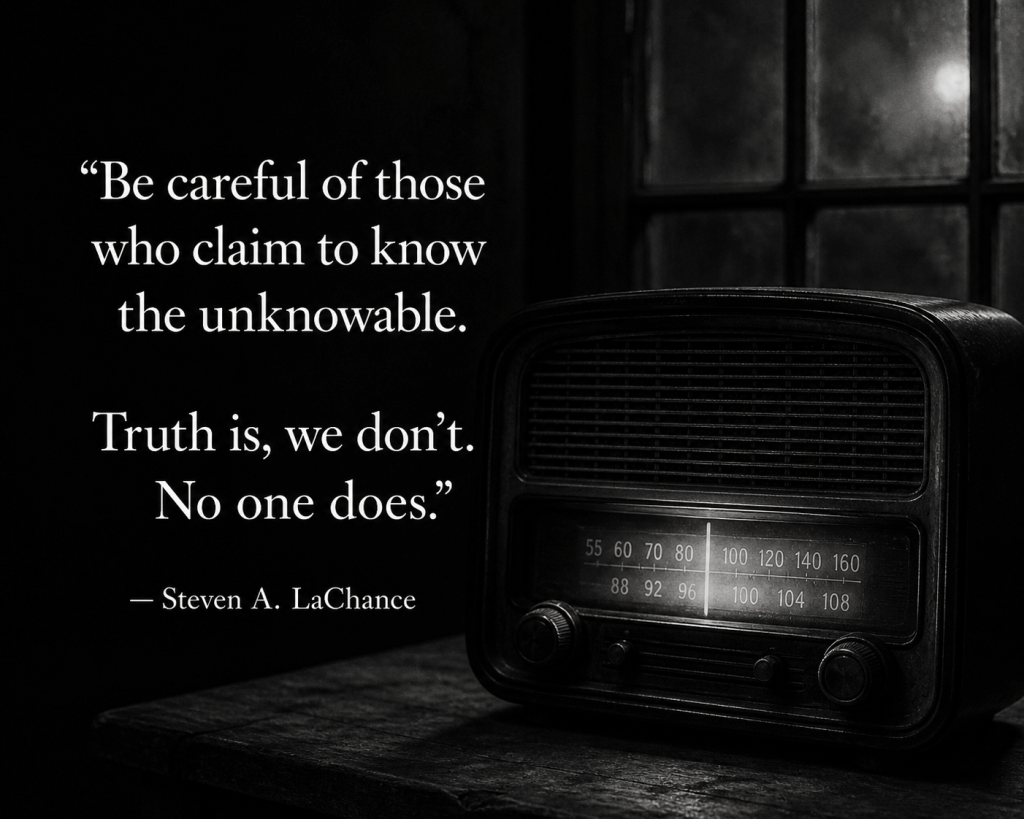
One of the things that has always frustrated me about parts of the paranormal world is the rise of the “all knowing” personality. You know the type. Every discussion eventually circles back to what “Spirit told them,” what they alone supposedly understand, or why their interpretation carries more weight than anyone else’s in the room.
That mindset does more damage to the paranormal than skepticism ever could.
The unexplained already exists in a difficult space. It touches grief, trauma, fear, belief, religion, psychology, culture, memory, and personal experience. None of those things are simple. Yet some people move through these conversations with absolute certainty, speaking as though they have direct access to truths nobody else can question.
That is where I stop listening.
I am not dismissing the possibility that people experience things they cannot explain. I have spent too much of my life around strange experiences to do that. I absolutely believe intuition exists. I believe human beings can sense atmospheres, emotional shifts, patterns, and moments that feel deeply profound. I also believe some experiences genuinely leave us without answers.
But “without answers” is the important part.
The moment someone says, “Spirit told me,” in a way that shuts down discussion or elevates their opinion above everyone else’s, the conversation stops being exploration and starts becoming performance. Suddenly their interpretation is untouchable because it supposedly comes from some supernatural authority rather than from a human mind capable of error, projection, ego, trauma, bias, or misunderstanding.
And that raises an entirely fair question:
How do we know the voice they are hearing is not simply themselves?
Human psychology is incredibly layered. Trauma reshapes perception. Identity is fluid. Suggestion is powerful. Ego is powerful. Dissociation exists. Projection exists. The subconscious is capable of remarkable things. None of that automatically means someone is lying, but it does mean we should approach certainty with caution.
Questioning those possibilities is not cruelty. It is critical thinking.
Unfortunately, many people in paranormal spaces treat questioning as hostility because certainty has become part of their identity. If you challenge the claim, you are not just challenging an idea. You are challenging the role they have created for themselves as the chosen interpreter of mystery.
I have always trusted the people who say:
“I do not fully know.”
“This is only my interpretation.”
“There may be multiple explanations.”
That kind of humility feels far more honest to me than someone presenting themselves as a spokesperson for the universe.
The irony is that the paranormal should be one of the few areas where humility comes naturally. We are discussing subjects humanity has debated for thousands of years without reaching universal agreement. Spirits, hauntings, consciousness, the afterlife, religion, psychology, dimensional theories, environmental explanations, memory imprints, symbolism, all of it exists inside uncertainty.
And maybe that uncertainty is exactly where the honest conversation belongs.
Not in certainty.
Not in ego.
Not in performance.
But in the willingness to admit that sometimes we simply do not know.
 Steven LaChance Blog
Leave a comment