I’ve been reading a great deal lately about humanity’s place in the universe. The deeper I go, the more fascinated I become by one simple fact. Across thousands of years, civilizations that never knew one another often arrived at remarkably similar questions about reality itself.
I’ve spent time in Sumerian texts, Buddhist teachings, Greek philosophy, and many other ancient writings. They use different languages and different symbols, but they often point toward the same possibility: that what we experience every day may not be the deepest level of reality. Whether they described it as illusion, spirit, consciousness, or divine order, many believed there was something beneath the surface that we rarely perceive.
Even The Matrix, for all its science fiction, is really just the latest expression of an ancient philosophical question. Plato wondered if we were seeing reality or merely shadows on the wall of a cave. Buddhist teachings ask whether our perceptions veil ultimate reality. The Sumerians described a cosmos governed by forces beyond ordinary human understanding. Every age seems to discover its own metaphor, but the question never changes.
Part of the reason this fascinates me is personal.
Many years ago, I had a near-death experience. I don’t expect that experience to prove anything to anyone else, but it forever changed how I think about consciousness. I came away with the overwhelming sense that my mind was not my body. The body felt more like a vessel than the source of who I am. If that’s true, then the next question naturally follows.
How does that vessel become us?
Where does consciousness come from? Is it created by the brain? Does the brain receive it the way a radio receives a signal? Is consciousness fundamental to the universe itself? I don’t pretend to know the answer. In fact, the deeper I study these questions, the more comfortable I’ve become admitting how much I don’t know.
What continues to amaze me is that people have been asking these same questions since the dawn of civilization. They arrived at different conclusions, but they recognized the same mystery.
Perhaps that’s what connects us across time more than anything else. Not our answers, but our questions.
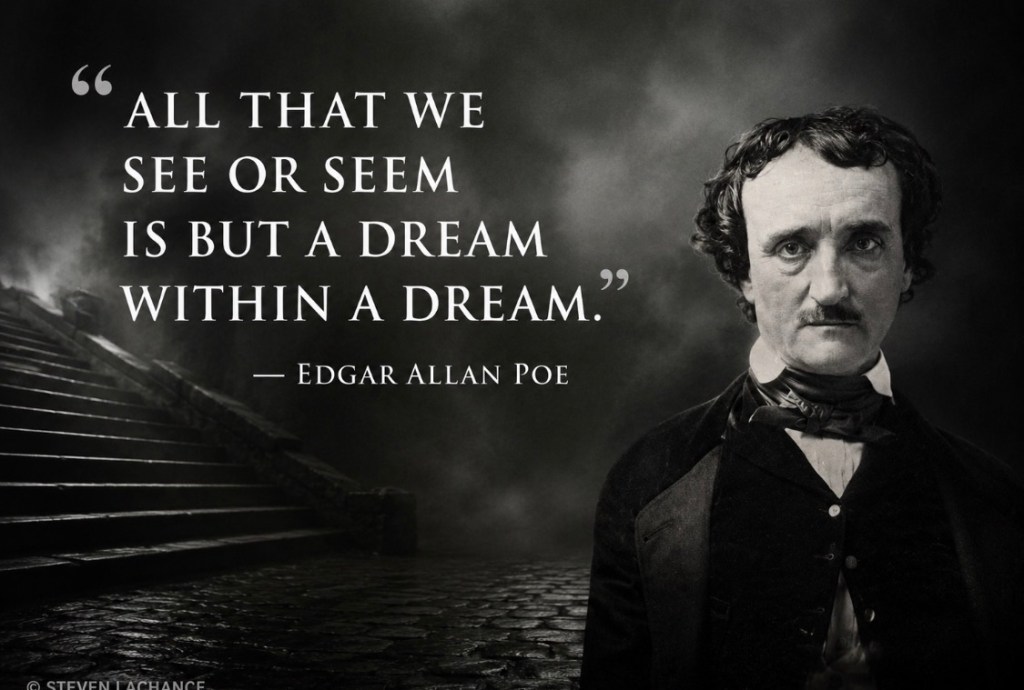
Edgar Allan Poe may have said it best:
“All that we see or seem is but a dream within a dream.”
 Steven LaChance Blog
Leave a comment