I spend some time every day reading paranormal pages and following the conversations people are having. Like many of you, I enjoy seeing what people are experiencing, photographing, questioning, and discussing. There are a lot of thoughtful people in this community, and I appreciate that.
Lately, though, I have noticed something that concerns me.
For years, one of the biggest criticisms aimed at the paranormal community was that some people seemed willing to believe almost anything. A blurry photograph became a ghost. A strange sound became evidence of a haunting. Every unexplained experience was immediately placed into a paranormal category. I understand why many investigators pushed back against that mindset. Healthy skepticism is important. Looking for ordinary explanations before extraordinary ones is part of doing responsible work.
The problem is that sometimes a correction becomes an overcorrection.
More and more, I see conversations where the answer seems to arrive before the investigation even begins. A photograph gets posted and people immediately call it pareidolia. Someone shares an experience and within minutes they are told it was sleep paralysis, stress, faulty memory, suggestion, or misidentification. The explanation may very well be correct, but what strikes me is how quickly people decide they already know the answer.
The truth is that most of us cannot determine exactly what happened from a single photograph, a short video, or a few paragraphs on social media. We can offer possibilities. We can point out things worth considering. We can compare experiences and observations. What we cannot do is know exactly what happened from such limited information.
That is why I have always thought paranormal investigation is a bit of a high wire act. Lean too far in one direction and you start believing everything. Lean too far in the other and you start dismissing everything. Neither approach leaves much room for discovery.
Over the years I have seen cases that turned out to have completely ordinary explanations. I have also seen cases that resisted those explanations no matter how closely they were examined. That does not automatically make them paranormal. It simply means the answer was not immediately obvious. The longer I have done this work, the less interested I have become in proving that something is paranormal and the less interested I have become in proving that it is not. What interests me is understanding what actually happened.
There is another reason I think balance matters.
Whether we like it or not, people listen to investigators, researchers, content creators, and experienced members of the paranormal community. The opinions we share influence how others interpret their own experiences. If we believe everything, we risk leading people toward conclusions that may not be supported by the evidence. If we dismiss everything, we risk doing the opposite. Either way, we are no longer following the evidence. We are following our own assumptions.
That is why I have always been cautious about extremes. The person who automatically calls every anomaly a ghost is not doing real investigation. The person who automatically dismisses every anomaly as pareidolia is not doing real investigation either. Both have already decided on the answer before the work begins, and once that happens the investigation is often little more than an attempt to justify a conclusion that has already been reached.
I also think television has done the paranormal community a disservice in some ways. Most paranormal shows are designed to fit neatly into an hour. A mystery is introduced, evidence is gathered, conclusions are reached, and the credits roll. It makes for good television, but real research rarely works that way.
Real research is messy. It can take weeks, months, or even years. Sometimes you spend all that time only to discover there is a perfectly ordinary explanation. Sometimes you spend the same amount of time and still find yourself with unanswered questions. Sometimes the most honest conclusion is that there is no conclusion.
I know that can be frustrating because people naturally want answers. We want the mystery solved. We want the story to make sense. We want things tied up neatly with a bow. But that is not always how investigation works.
Not everything is a ghost. Not everything is pareidolia. Not every witness is right, and not every witness is wrong. Most of the time the truth is somewhere in the middle, which is why I think we have to keep walking that tightrope. Lean too far toward believing everything and you can mislead people. Lean too far toward dismissing everything and you can do exactly the same thing. The responsibility is to stay balanced and follow the evidence wherever it leads, even when the answer is not the one we expected.
Maybe that is why I have never been completely comfortable in either camp. I have spent too many years seeing cases that were eventually explained, and too many years seeing cases that were not. Even when it comes to my own experiences, I still do not claim to have all the answers.
People often assume that because I wrote The Uninvited I must know exactly what happened in that house. The truth is that I do not.
I know what I experienced. I know what my family experienced. I know how those events affected our lives. What I do not know is whether I can explain every part of it with confidence. After all these years, there are still pieces I do not fully understand.
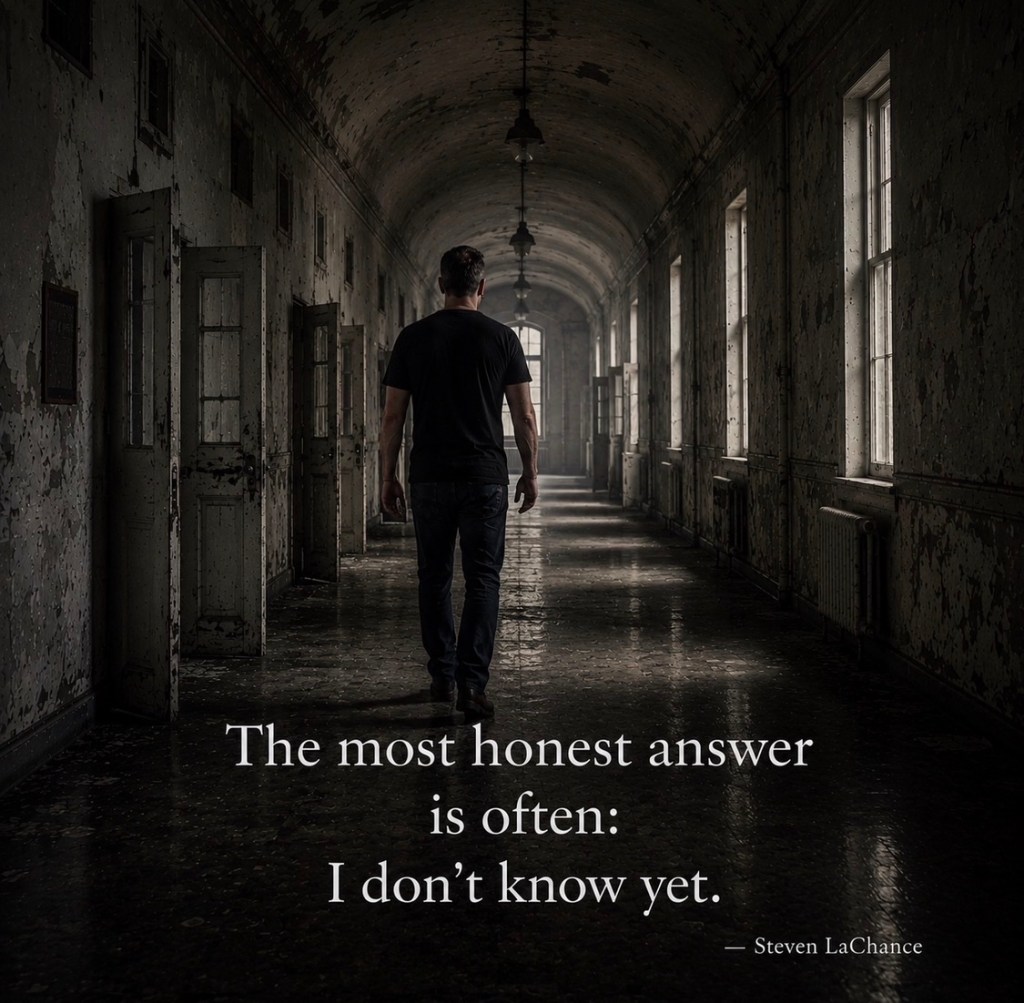
For me, the most honest answer has often been, “I don’t know yet.”
After all these years, I have come to believe that those four words are not the end of an investigation. They are often the beginning.
Maybe that is the real challenge of this work.
Staying curious.
Staying skeptical.
Staying open.
Not everything is a ghost.
Not everything is pareidolia.
Sometimes the most honest answer is simply:
“I don’t know yet.”
Be good to each other and keep those minds open.
 Steven LaChance Blog
Leave a comment