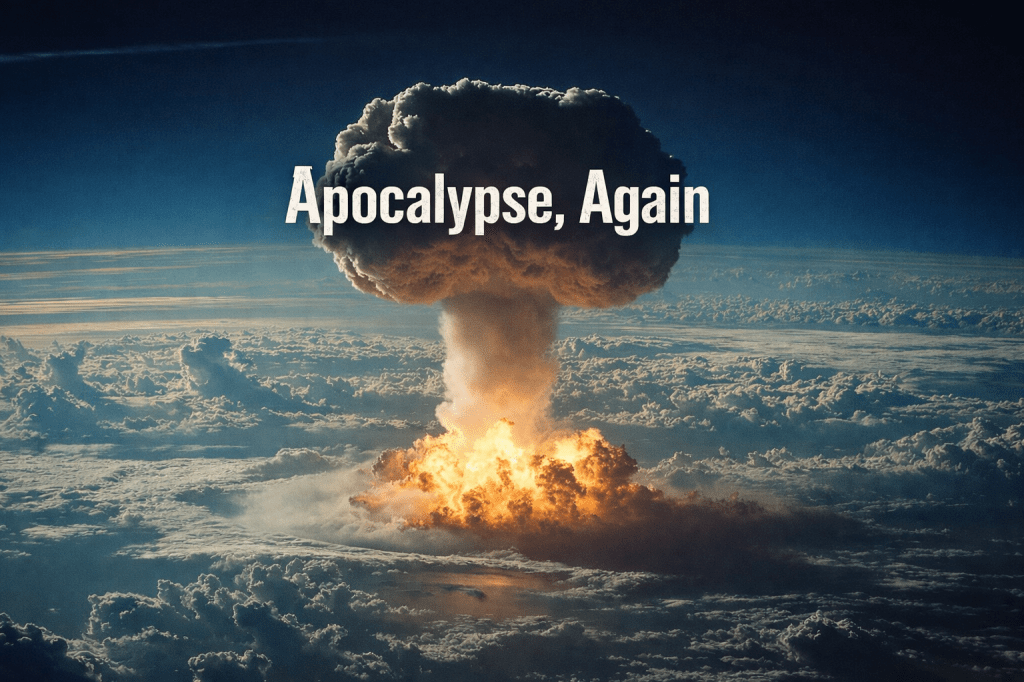
Lately I have been seeing more and more people say the same thing.
That everything happening in the world right now was predicted in the Bible.
Wars. Political tension. Disasters. Social division. For many people it feels like history is building toward something final, something foretold long ago.
I understand why people feel that way. When the news is heavy and the future feels uncertain, it is natural to look for meaning in what is happening around us. Religion has always provided a framework for that. It offers a story about where humanity has been and where it might be going.
I have heard this idea many times over the years, and every time it surfaces it carries the same sense of urgency.
But when we step back and look at history, something important becomes clear.
People have believed they were living in the end times for nearly two thousand years.
When the Roman Empire began to crumble, many Christians believed the prophecies in Revelation were unfolding right in front of them. The world they knew was collapsing. Governments were falling. Armies were moving across Europe. To them it looked exactly like the turmoil scripture described.
Centuries later the Black Death swept across Europe and killed tens of millions of people. Entire communities vanished. Many believed humanity had reached the final days described in the Bible.
The same fear surfaced again in 1918. The First World War had devastated much of the world, and at the same time a global influenza pandemic was spreading across continents. Entire cities shut down. Millions died. Many people believed humanity had reached the final chapter of its story.
Predictions were made. Dates were suggested. Books were written explaining how prophecy was unfolding in real time.
History even records moments when people believed the exact date of the end had been discovered.
In the early nineteenth century an American preacher named William Miller studied the Bible and concluded that Christ would return in 1844. His message spread quickly. Thousands of followers, known as Millerites, believed the prophecy was certain. Some sold their property. Others gathered in prayer, waiting for the moment the world would change.
October 22, 1844 came and went.
Nothing happened.
The event became known in history as the Great Disappointment. Many believers quietly returned to ordinary life. Others reinterpreted the prophecy and continued their faith in different forms.
Like many predictions before it, the certainty of that moment passed while history kept moving forward.
A similar wave of end time expectation appeared again in the twentieth century. In 1970 a book called The Late Great Planet Earth by Hal Lindsey became an international bestseller. The book argued that biblical prophecy was unfolding in the modern world and suggested that the final events of history could arrive within a single generation.
Millions of people read it. Churches held study groups about it. Entire communities believed the end of history might come before the end of the century.
But the century passed.
History continued.
The Bible does contain apocalyptic writing, especially in books like Daniel and Revelation. These passages describe war, upheaval, disasters, and the collapse of powers. The imagery is vivid and dramatic.
But those descriptions are also broad. War has been part of human history in every century. Disasters have always happened. Political instability has never been rare.
Because of that, almost any turbulent moment in history can seem to match those passages.
There is also something very human in how we interpret events. We naturally notice things that confirm what we already believe. If someone believes the world is approaching a prophetic end, every troubling headline can begin to feel like evidence.
At the same time, many biblical scholars point out that parts of Revelation were written in the context of the Roman Empire. The symbolic language reflected the oppression and struggles people were facing in that moment.
For the earliest readers, the book was not describing events two thousand years in the future. It was helping them make sense of their own time.
And perhaps that is part of why every generation since has seen itself reflected in those same words.
None of this dismisses faith. Faith has always helped people navigate uncertainty and fear. It gives people a sense that history has meaning even when events feel chaotic.
But history also teaches humility.
For centuries people have believed the end was near.
And yet the world keeps moving forward.
New generations are born. Wars end. Societies rebuild. Humanity continues, carrying both its mistakes and its hope for something better.
Maybe the real lesson is not that we are living in the final chapter.
Maybe the lesson is simpler than that.
Every generation eventually reaches a moment when the world feels unstable and frightening. And in those moments people begin to wonder if they are living at the end of the story.
History suggests something different.
The story is usually much longer than we think.
 Steven LaChance Blog
Leave a comment