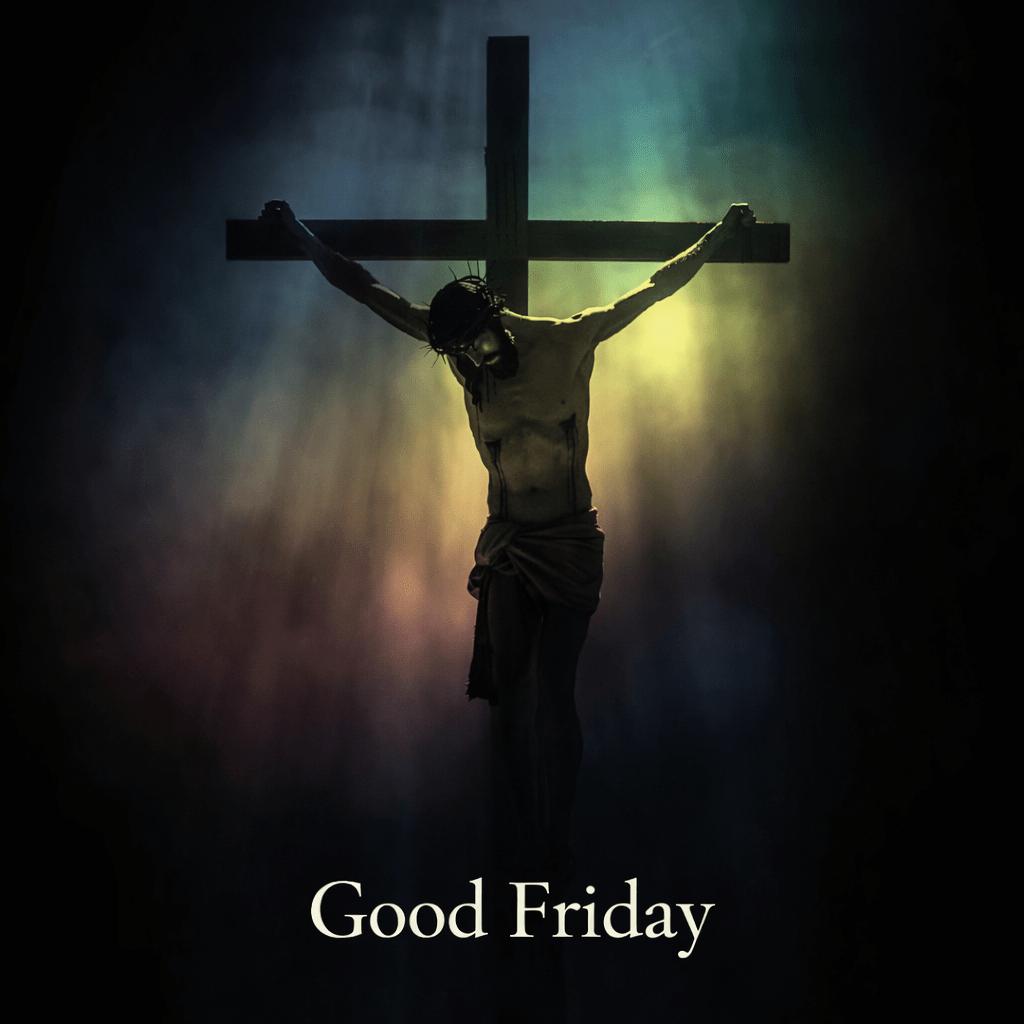
I have been thinking about Good Friday. Not just as a day on a calendar, but as a moment that changed the course of the world and history in a way that is hard to fully take in. It is often told quickly, moved through on the way to something else. But when you slow it down, when you actually sit with it, it becomes something very different.
After the betrayal in the Garden of Gethsemane, everything changes.
Up until that moment in the texts, there is still space. Space for something to be interrupted, for someone to step in, for a different outcome to take hold. But once Jesus is taken, that space begins to close quickly.
What had been building quietly during the week does not stay hidden anymore. It does not all happen at once. But once it begins, it keeps going. From there, the momentum accelerates. By the time he is brought before the authorities, it is already there, the final outcome has already been set.
He is questioned. He is moved from one place to another, passed between those in power until he stands where the final decision will be carried out.
Not confusion. Not hesitation.
Something already decided.
He is no longer just a man moving through events. He has become the point where everything is directed. The fear. The pressure. The need to bring something to an end.
And once that happens, it becomes difficult to see anything else.
By the time he stands before Pontius Pilate, the man Rome placed in charge of keeping order in Jerusalem, this has moved beyond the crowd. Now it is in the hands of Rome.
And this is where the accounts begin to shift. Not in what happens, but in where they stand.
One account stays close to the exchange. The questions. The answers that do not change anything. The silence where something should have shifted, and does not.
Another account moves outward. The crowd. The choice placed in front of them. One man released. One man kept. The moment where everything could have gone a different way, and didn’t.
And in another account, the focus stays with Pilate. Watching him try to understand what is in front of him. Looking for something that would justify what is being asked. Not finding it.
They are not separate.
They are the same moment.
Seen from different angles, but with the same outcome as the crowd begins to call for crucifixion.
And in the middle of it, there is an exchange that stands out. Jesus speaks about his kingdom, not in a way that fits what is happening around him, but in a way that places him outside of it. And that gives Pilate something to hold onto, something he can name in terms Rome understands.
“So you are a king?” Pilate asks.
It is not a declaration. It is a question, a way of placing this moment into something that can be acted on, because Rome does not respond to belief. It responds to what it sees as a threat.
And at that point, the direction is clear.
Whip him. Humiliate him. Crucify him.
This is what it looks like when a person becomes the focus of something larger than themselves. When a crowd no longer sees clearly and begins to move. It is not isolated to this moment. It is something we recognize.
He is led out.
Through people who watch, who follow, who keep their distance. Some still seeing him. Others no longer willing to.
And this is where the moment becomes something else. Not just a decision, but its outcome. The cross is not separate from what came before it. It is where it leads.
And at the center of it, there is no distance. There is someone enduring it, fully aware, fully present, human.
And there is something else here that cannot be set aside. His mother is there. She does not move in and out of the moment the way others can. She does not turn away. She stands there and remains in it, watching what is being done to her son with no way to stop it. There is nothing abstract about that. No distance. Just the reality of it, moment by moment, as it unfolds in front of her.
And that is not separate from what is happening. It is part of it. Because when something like this takes hold, it does not end with the person it is directed at. It reaches outward. It leaves others standing there, forced to witness what they cannot change. We have seen that before, and we have seen it since.
And still, it continues. No interruption. No moment where it turns back. The crowd does not step in. Authority does not step back. And the man at the center of it remains inside it, until there is nothing left to be done.
His body is nailed to the cross.
Have you ever had a dream where you were standing in the moment of the crucifixion, or one like it?
I have.
They stay with you. And for me, it is always the faces that remain. The expressions of the people. The way a crowd changes once it begins to move together. The look of it when individuals stop being individuals. When something else takes over.
You see it in the crowd. You see it in Pilate, standing firm in his role, already knowing he can step away from it when it is over. You see it in the ones who cannot step away. His mother. Mary Magdalene. Standing there, watching what they cannot stop.
That is what stays.
And when you sit with it long enough, it begins to open in a different way.
In some of the Gnostic writings, there is an idea that salvation does not come from outside of us, but from within. That it is a matter of seeing clearly. Of recognizing truth when it is in front of us, holding it, and choosing how to live with it.
And when you look at the crucifixion through that lens, it begins to open differently.
It is not clean.
It is not distant.
It is violent. It is unfair. It is the darker side of human behavior placed in full view.
And maybe that is where its power sits.
Not just in what was done, but in what it shows.
A mirror.
Something that allows us to see how far things can go when fear takes hold, when people stop seeing each other clearly, when a crowd moves without stopping to question where it is going.
The lesson is not complicated.
Love thy neighbor as thyself.
And then we are shown what happens when that is set aside. Maybe that is part of what his sacrifice was meant to hold.
Not just for that moment.
But for every moment that would follow.
Because this does not stay in the past. We recognize it because we have seen it before, and we continue to see it now.
The same pattern.
The same movement.
The same outcome.
This is not just a story.
It is something we have not yet learned from.
In the moment of the crucifixion, it all comes to an end.
“It is finished: and he bowed his head, and gave up the ghost.”
 Steven LaChance Blog
Leave a comment