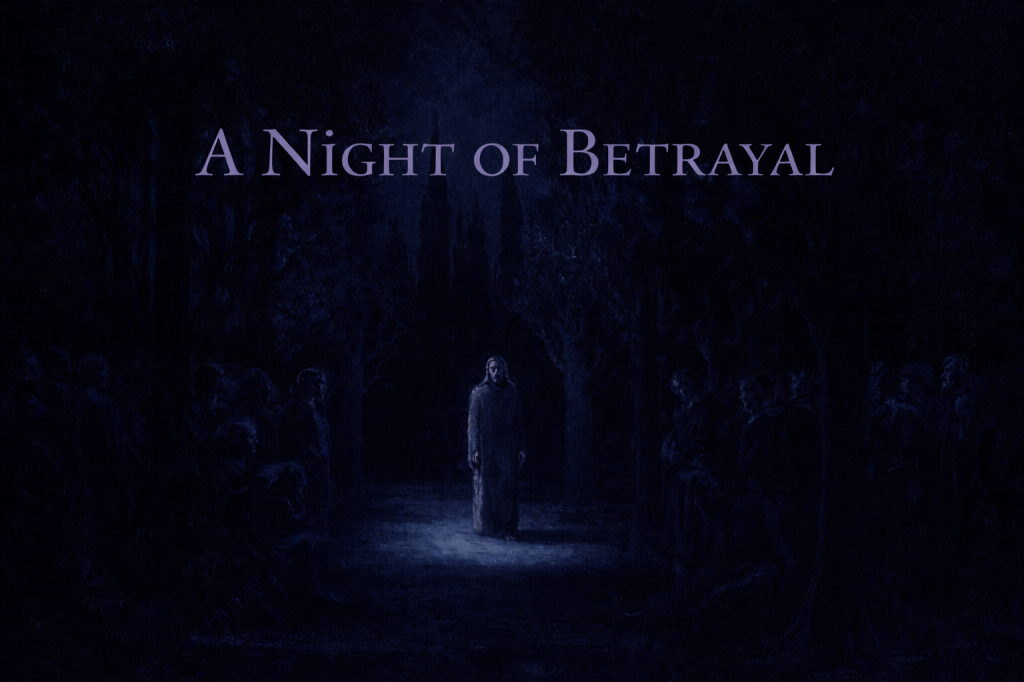
Lately, I have been spending time in some of the most ancient biblical texts we have, not just reading them, but really contemplating them. Looking at what was kept, what was emphasized, and what seems to have been left behind along the way. There is a quiet pattern that starts to emerge when you do that long enough. Organized religion, for all it has preserved, has also shaped the story in ways that feel… selective. Not necessarily false, but incomplete. And when you begin to notice that, certain moments begin to stand out differently than they used to.
Maundy Thursday has always felt like the quiet middle of the story to me. More than that, it has always felt the most human. It is the part people move through quickly, almost out of habit. You hear about the Last Supper, and then the next thing you know, you are at the cross. Somewhere in between, this night gets reduced to a few familiar moments, a meal, a betrayal, something that feels almost orderly when it is retold from a distance.
But it was not orderly. It was not clean. And it was not simple.
This is the night where everything begins to come apart.
It starts at a table. Food is passed, conversation moves, there is a sense of familiarity, the kind of setting where people assume things will continue the way they always have. But underneath that surface, something is already shifting. Jesus is speaking in ways they do not fully understand. He is already facing what is coming, and they are still moving inside the comfort of what has been. He is trying to prepare them, and they cannot quite meet him where he is. You can feel that distance forming before anything has visibly gone wrong.
And then it begins, not all at once, but in small, human fractures.
He speaks plainly, and they still do not hear it. Not because the words are hidden, but because they are not ready to take them in. He is trying to reach them, to steady something before it breaks, and you can feel it slipping.
The moment is there, right in front of them, and it passes anyway.
One by one, the knots begin to loosen. The quiet bonds that have been holding everything together start to give way. Not in some dramatic break, but in small failures. Missed understanding. Attention drifts. The inability to stay present when it matters most.
By the time they reach the garden, it is already happening.
He asks them to stay awake, and they fall asleep.
And there is something almost unbearable in that. Not because of what it means theologically, but because of how familiar it is. Someone asking not to be left alone in a moment that matters, and the people closest to them cannot stay with him.
It did not arrive in a single moment.
It came undone.
The betrayal we remember is the kiss of Judas Iscariot. It is visible. It gives the story a clear point, something we can hold onto and say, that is where it happened.
But it is not where it began.
Judas seals it with a kiss. But by then, the betrayals have already been unfolding in different moments, in quieter ways. And even after Jesus is led away, it does not end. It continues with Peter.
Peter stands close. He insists he will never turn. He believes it when he says it. But when fear enters the room, everything shifts. He denies even knowing him. Not once, but three times. Not out of cruelty, but out of something far more familiar.
Fear has a way of rewriting what we think we are capable of.
That is what makes this day essential, because it removes the distance. It does not allow the story to stay symbolic or contained. It brings it into the reality of human behavior, where loyalty is not measured by what we say, but by what we do when pressure closes in.
And even at the center of it, you see that same humanity.
In the garden, there is no performance. There is no distance. There is someone who knows what is coming and does not want it. Someone who asks, if it is possible, for it to pass. That moment matters, because it reminds us this is not a figure untouched by feeling. This is someone fully human within his own thoughts.
I think at times we are afraid to look at that. The human Jesus. And maybe that is why modern tellings move through this so quickly.
The loneliness of that night is not just in what happens to him.
It is in how alone he becomes while still surrounded by others.
That is the part that gets lost when the story is told too quickly. We move from the meal to the cross and skip over the space in between, the place where everything reveals itself. Not just who betrayed him, but how it happened.
Quietly. Gradually. In ways that feel uncomfortably familiar.
For me, it all leads to that moment in the garden.
After the table. After the missed words. After the slow unraveling that had already begun. After the distance that formed before anyone fully understood it was there.
It comes down to this.
A man who knows what is coming. Who feels it fully. Who does not want it.
And finally says it out loud.
“Father, if you are willing, take this cup from me; yet not my will, but yours be done.”
 Steven LaChance Blog
Leave a comment