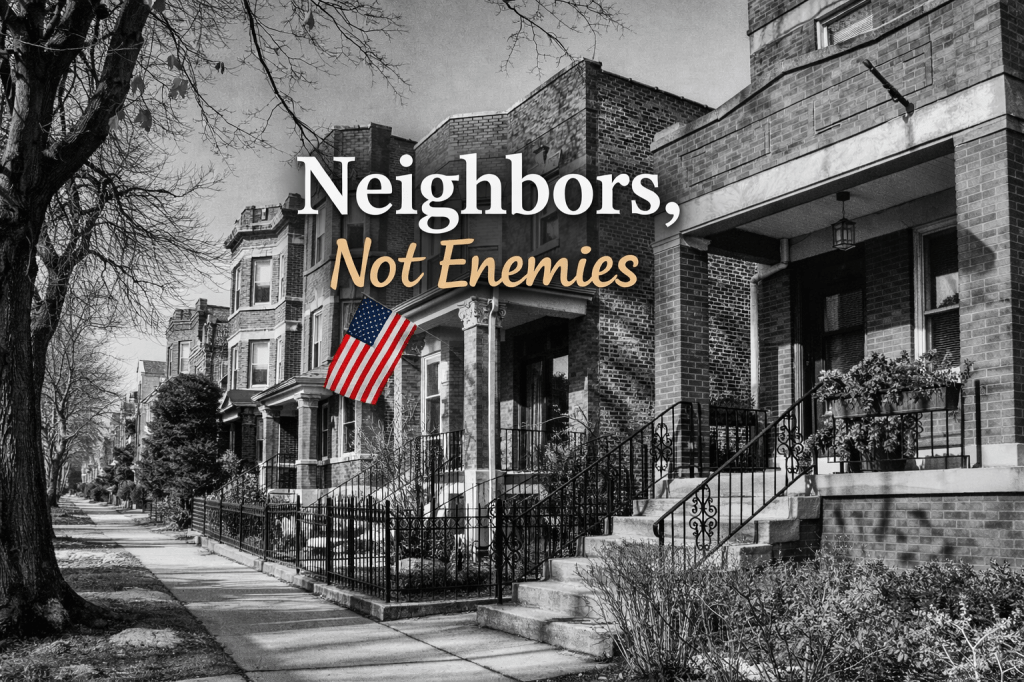
You know what has been bothering me lately about the state of things in the United States? How much of what we are living through feels rooted in hating your neighbor. Not debating policy. Not wrestling with ideas. Not even arguing about the direction of the country. It feels personal now. It feels aimed at the people standing next to you in line at the grocery store or living across the street.
Somewhere along the way we stopped talking about solutions and started talking about each other. Who belongs. Who does not. Who deserves help. Who should be blamed. Everything gets reduced to identity. Where you came from. What language you speak. Who you love. What church you attend or do not attend. Even what sign is in your yard becomes a reason to sort you into a category.
It feels intentional. Fear travels fast. Outrage moves quicker than understanding. Division keeps everyone busy while power quietly reshuffles itself behind closed doors. Immigration stops being about systems and becomes about “those people.” Healthcare stops being about access and becomes about worthiness. Education becomes indoctrination. Poverty becomes laziness. Difference becomes danger. And before you realize it, your neighbor is no longer a person. They are a problem.
I think about this a lot, especially at this stage of my life. I have lived long enough to know that most people are just trying to survive their own private storms. They are raising kids, caring for aging parents, juggling bills, carrying grief nobody else sees, holding stories they do not talk about. Most people are not monsters. They are tired. They are scared. They are doing the best they can with what they have.
I grew up in a time when neighbors borrowed sugar and kids rode bikes until the streetlights came on. You might disagree with someone’s politics, but you still helped them shovel their driveway or watched their house while they were out of town. That did not make us naïve. It made us connected.
Now connection feels fragile. Conditional. Transactional. We are encouraged to catalog each other instead of know each other. People get reduced to labels and talking points, sorted into tribes, and defended or attacked like abstractions instead of human beings. That is how empathy erodes, slowly and quietly, through headlines and comment sections and casual jokes that harden something inside us.
I do not believe this is who we really are.
I believe most Americans still want dignity, safety, fairness, and a chance to build a decent life. I believe most people still want to feel seen and respected, not erased or blamed. But every day we are nudged to look sideways instead of upward. To fight each other instead of questioning systems. To direct our anger toward neighbors instead of asking who benefits from that anger in the first place.
That matters, because when we forget each other’s humanity, we become easier to manipulate.
I am not interested in rage anymore. I am interested in remembering. Remembering that disagreement does not require cruelty. Remembering that the person across from you is carrying a whole life. Remembering that a country does not heal by tearing itself apart.
We do not have to agree on everything. But we do have to live together. And that starts with choosing, again and again, to see the person in front of us as human first, not a stereotype, not a headline, not a target. Just a person doing their best to make it through another day.
Sometimes that choice feels small. But small choices, repeated enough times, change the direction of a culture. And right now, more than anything, we need to find our way back to each other.
 Steven LaChance Blog
Leave a comment