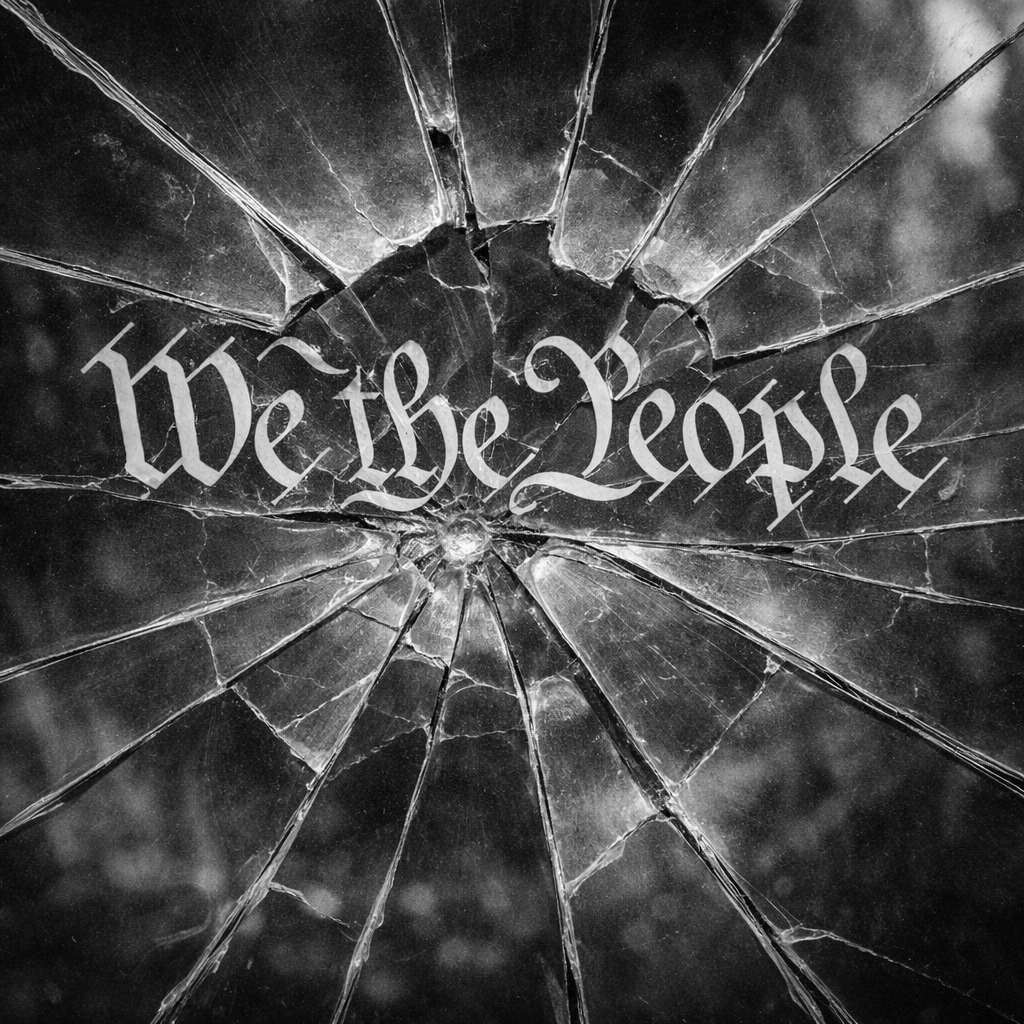
I keep thinking about how different things might feel if we actually lived in a country of ideas. A place where “We the People” meant everyone. Not some of us. Not the protected. Not the powerful. Just all of us.
But we never have. And that truth stings more than I want to admit.
What we are watching now is not a country falling from grace. It is a story collapsing. A story we were raised inside. A promise spoken as if it had already been kept. A dream repeated so often it began to feel like memory. Even Martin Luther King Jr. framed it honestly when he said, “I have a dream,” not “we have arrived.” He was naming a hope, not describing a reality. What hurts is not that something was taken from us. It is realizing that much of it was never real to begin with.
From the beginning, the promise was conditional. The country was founded while slavery was legal, Indigenous land was being taken by force, and women were excluded from political life entirely. “All men are created equal” was written by people who did not mean it literally. The contradiction was not accidental. It was built in.
A lot of what we were taught to believe simply was not true. At least not for everyone. The narrative worked well enough for some people that it passed as universal. Freedom. Equality. Opportunity. The words were real. The application was selective. After World War II, government programs helped create the modern middle class, but many Black families were excluded through housing discrimination, redlining, and lending practices that made homeownership inaccessible. What looked like stability for one group was locked doors for another.
What felt like safety to some was surveillance to others. Labor movements were crushed. Civil rights leaders were monitored, jailed, and assassinated. Queer people learned early that visibility could cost them their jobs, their families, or their lives. Native communities were relocated, erased, and told it was progress. Immigrants were welcomed when they were useful and criminalized when they were not.
We were not just wronged. We were misled. Sometimes deliberately. Sometimes through silence. Sometimes through repetition so steady it faded into the background of our lives. We were taught to confuse aspiration with reality and promise with proof. And if the system worked for you, even imperfectly, there was little reason to question who it failed or why.
For those it never worked for, the truth was always right there. It was just easier not to look.
I think the exhaustion so many of us feel now comes from watching that illusion finally crack. It is tiring to hold the gap between who we say we are and how we actually behave. It is tiring to watch fear rewarded, cruelty normalized, and division cultivated on purpose. Politicians have learned that you can dismantle protections quietly as long as you give people someone to blame loudly. None of this happened by accident. These were choices. Repeated. Reinforced. Justified.
Sometimes I imagine how different it would feel if we lived in a country where people were rested.
Not because life was easy, but because it was fair. Because survival was not a daily calculation. Because healthcare was care, not a privilege tied to employment. Because housing was shelter, not a speculative asset. Because work was not treated as a measure of human worth. Parents would sleep without doing math in the dark. Aging would not feel like a threat. Exhaustion would stop being mistaken for virtue.
In that country, government would not feel like a distant enemy or a hostile force. It would feel like something we built together and were responsible for maintaining. Imperfect. Human. Accountable. Power would mean service, not dominance. Protection, not punishment. “We the People” would not be a slogan pulled out when convenient. It would be the operating principle.
The hardest thing to admit is that none of this is fantasy.
Countries with stronger social safety nets, universal healthcare, and lower inequality already exist. They did not arrive there by accident or exceptional morality. They made choices. Hard ones. Collective ones. That is what sharpens the grief. We are not mourning a home that was destroyed. We are mourning the realization that we never finished building it. That for generations, we settled for the story instead of doing the work.
There is clarity in admitting that. Painful clarity, but honest.
The United States is a country of laws for the middle class and the poor. Not for the wealthy. The rules change depending on how much money you have, what you look like, who you love, what you believe, and where you come from. Once you see that clearly, you cannot unsee it.
The American Dream was not stolen. It was sold. Sold to the majority of “We the People” as if it were attainable for all, when it never was. Not equally. Not honestly. What we call democracy functions more like managed consent. Power follows money, and money is protected above almost everything else.
The truth is, we outnumber the wealthy who benefit from this arrangement. They remain in control not because they are many, but because they have learned how to use us to protect them from accountability. They keep us divided, distracted, and fighting one another so we never look directly at who profits from our exhaustion.
The problem is not the people around us trying to survive. It never was. The problem is a structure that depends on division to endure. A system that asks ordinary people to defend the interests of those who will never share their risk, their fear, or their consequences.
At some point, clarity has to replace confusion. Not violence. Not chaos. Just the refusal to keep mistaking manipulation for loyalty. The refusal to keep protecting wealth while our families absorb the cost.
Our children deserve better than this. They deserve truth instead of distortion. Safety instead of constant instability. Stability without fear. Justice that applies to everyone, not just those who can afford it.
That is the responsibility we keep avoiding. And it is the one thing that actually matters.
 Steven LaChance Blog
Leave a comment