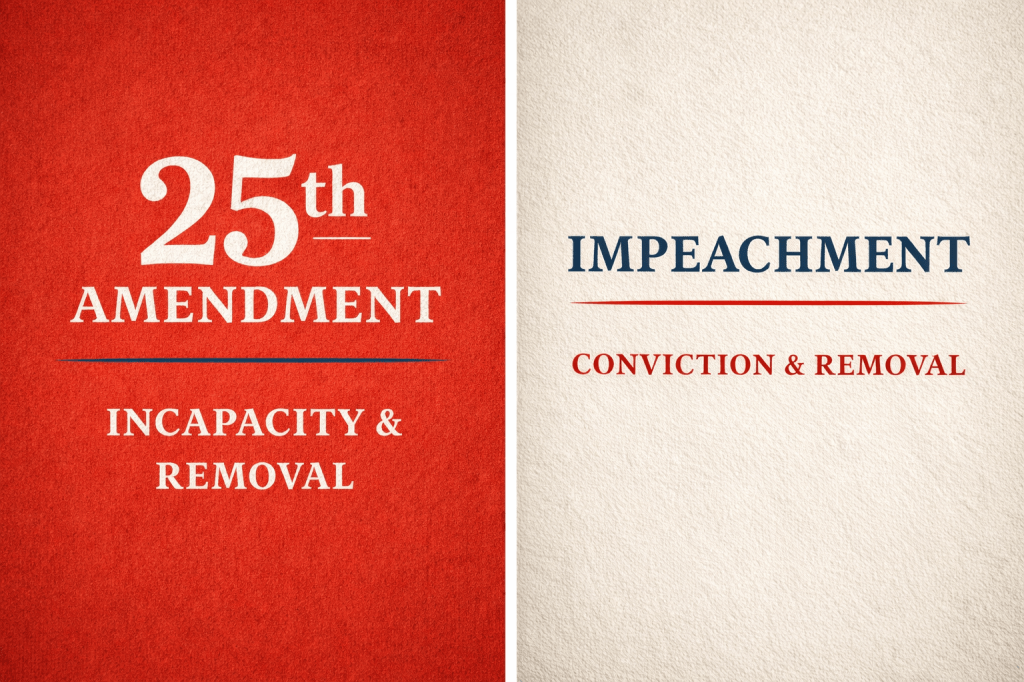
The Twenty Fifth Amendment exists for one reason: to protect the country if a president is unable or unwilling to safely perform the duties of the office.
It can be invoked in two ways. A president can voluntarily transfer power to the vice president, most often for medical reasons. The more serious provision allows the vice president and a majority of the Cabinet to declare that the president is unfit to serve. That declaration goes to Congress, and the vice president immediately becomes acting president. If the president disputes it, Congress must vote. A two thirds majority in both chambers is required to keep the president removed.
This amendment is not about party or policy disagreements. It is about capacity, judgment, and danger.
People are raising it now in relation to Donald Trump because of a sustained pattern that includes admiration for authoritarian leaders, hostility toward democratic norms, repeated talk of using the military domestically, reckless rhetoric toward allied nations, and a growing willingness to test constitutional limits. These are not isolated remarks. Taken together, they form a trajectory that alarms constitutional scholars, national security experts, and former military leaders across party lines.
There is also impeachment, and it matters just as much. Members of his own party have stated publicly that if he attacks a United States ally, they would move immediately to end his presidency. That is not casual talk. Impeachment only becomes viable when support fractures from within, and threats to allies move the situation out of partisan politics and into global security and treaty obligations.
Impeachment begins in the House of Representatives with a simple majority vote. Conviction and removal require a two thirds vote in the Senate. That bar is high, but history shows it can be reached when national security is clearly endangered. An unprovoked attack on an ally is not a policy disagreement. It is a constitutional crisis.
These two mechanisms serve different purposes. Impeachment is punitive and retrospective. It addresses misconduct after it occurs. The Twenty Fifth Amendment is preventative. It exists to stop a dangerous situation in real time. In a rapidly escalating crisis, the Twenty Fifth Amendment can act immediately, while impeachment follows as accountability.
The odds of either happening are still low. Power rarely restrains itself voluntarily, and people risk their careers by acting. But low odds do not mean no odds, and silence guarantees nothing changes.
The danger of waiting is real. One impulsive decision can destabilize alliances, provoke war, or turn the power of the state inward against its own citizens. These safeguards exist because the framers understood something essential: waiting for catastrophe is not leadership. It is negligence.
If you want your voice heard, contact your representatives. Call and write your members of Congress. Contact the offices of the vice president and Cabinet officials. Be calm, factual, and clear. Ask what safeguards they believe are in place and what lines cannot be crossed.
Most importantly, talk about this openly. With friends. With family. In public spaces. Democracies do not survive on silence or blind faith. They survive when informed citizens understand how their government works and insist those systems be taken seriously.
Understand what is happening in our government and how it actually works. Do not rely on fear, rumor, social media spin, or loyalty to personalities. At this point, facts are not optional. They are the only thing that matters.
 Steven LaChance Blog
Leave a comment