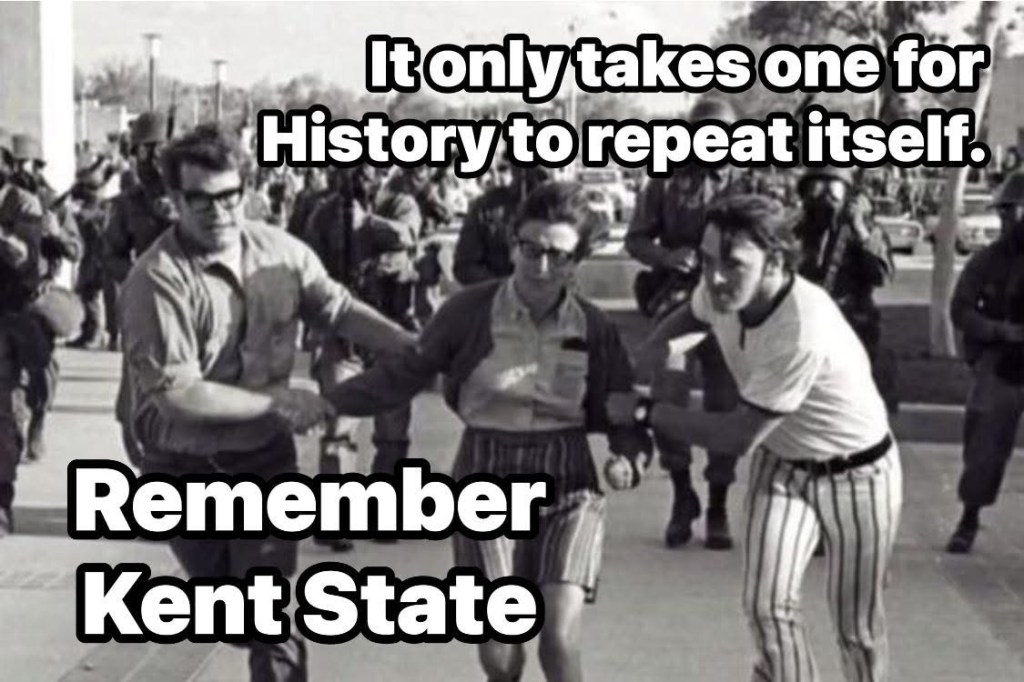
History has a short memory. Kent State was not an accident—it was a warning.
It only takes one.
The danger of what lies ahead feels familiar to anyone who remembers Kent State. On May 4, 1970, in Ohio, a group of college students gathered on the Kent State University campus to protest the expansion of the Vietnam War into Cambodia. They were young. They were angry. They were unarmed.
The National Guard had been sent in after days of unrest. Soldiers with rifles stood across from students with signs. Tear gas hung in the air. And then, in a moment that lasted less than fifteen seconds, the unimaginable happened. The Guardsmen opened fire. Sixty seven bullets cut through the smoke and the morning air. Four students were killed. Nine were wounded. One was paralyzed for life.
There was no order to fire that could ever be justified. There was only confusion, fear, and a tragic overreaction. The image of that day, students running, crying, bleeding on the green lawn of their own university, became a symbol of how quickly control can be lost once the military is turned inward against its own people.
The lesson of Kent State is not only about that day. It is about what happens when the lines between law enforcement and the military begin to blur. It is about what happens when leaders use force meant for war to control dissent at home. History has shown us again and again that it only takes one. One frightened soldier. One reckless commander. One wrong decision.
We forget that the rules designed to keep the military out of domestic affairs exist for a reason. The Posse Comitatus Act was meant to prevent the use of federal troops as police. It was a safeguard for democracy. But each time that line is tested or ignored, we drift closer to repeating the mistakes of the past.
Today we see images of armored vehicles rolling through city streets. We see federal agents in tactical gear, their faces hidden, their names removed. We are told it is for our safety. We are told it is necessary. But history whispers a warning. It reminds us that when soldiers and citizens share the same streets, the cost of a single gunshot can echo for generations.
Cities are living, breathing things. They are crowded, emotional, unpredictable. In that kind of environment, the margin for error is thin. It does not take an army to turn a peaceful protest into a massacre. It only takes one bullet, one moment of fear, one finger too quick on the trigger.
After Kent State, four million students across the country went on strike. Universities shut down. The nation mourned. And yet, in the decades that followed, the same tension has returned in different forms. Each generation forgets until it happens again.
The danger now is not hypothetical. It is real. When armed forces are placed among civilians, every decision carries the weight of life and death. Every protest becomes a potential flashpoint. Every command becomes a gamble.
It only takes one.
That is the lesson. That is the warning. And if we forget it, we will learn it again the hard way.
 Steven LaChance Blog
Leave a comment