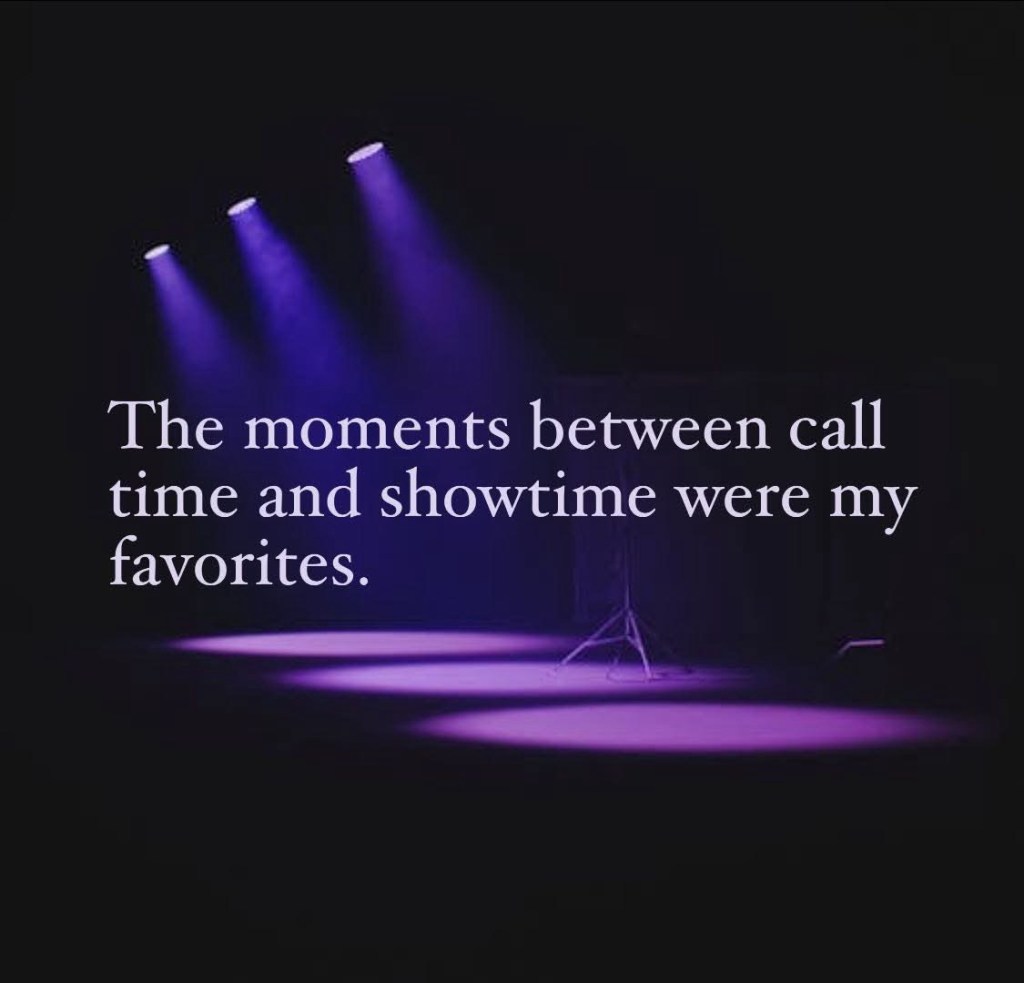
My favorite time in the theater has always been that quiet space between call time and performance. The house is still, the seats empty, the stage lights warming the air with their glow. It is a suspended moment when the outside world falls away and you are left alone with your breath, your body, and the work ahead. I would stand in the wings or sit silently in the dressing room, gathering my thoughts, focusing inward, letting the storm of nerves swirl until I could bend them into something useful.
What most people never knew is that I have terrible stage fright. I learned early how to hide it, how to cover the trembling with confidence, how to smile when my stomach was twisting itself into knots. Through the years I discovered I was not alone in this. Many of the greatest performers suffer from it too. It is not the absence of fear that makes a good actor. It is the ability to take that fear and shape it into energy, to let the nerves sharpen you, to make them work for you rather than against you.
I miss the stage. It was one of the few places in my life where I felt true freedom. In front of an audience I could play out emotions I could never express in my own daily existence. I could rage. I could laugh. I could weep. I could dream aloud. I could step into the skin of another and live there for a little while, tasting the possibility of what it might mean to be someone else entirely.
I have been everything from a man-eating plant to Hamlet, and each role carved something into me. The absurd and the profound, the comic and the tragic, the fantastic and the starkly human. So many different stages, each with its quirks and its challenges, but all sharing one sacred truth: creation took place upon them.
Every night the play was alive in a new way. Every performance was a birth that could never be repeated, because the art creates itself in the moment and then disappears into memory. That, I believe, is the key to good performance. To let the art live and breathe on its own each time, to step aside and allow it to come through you as if you are merely the vessel.
Theater is fleeting by its very nature. No two audiences are the same. No two nights are the same. You stand there, trembling and alive, and you give everything you have to strangers who will carry it away in their hearts, or perhaps forget it by morning. And yet for those hours, you and they are joined together in a communion of story, light, and sound.
I sometimes think life is a little like that. We play our parts, we find our marks, we improvise when the lines falter, and when the curtain falls, the performance exists only in the memory of those who were there to witness it. That is the beauty and the tragedy of it all.
 Steven LaChance Blog
Leave a comment