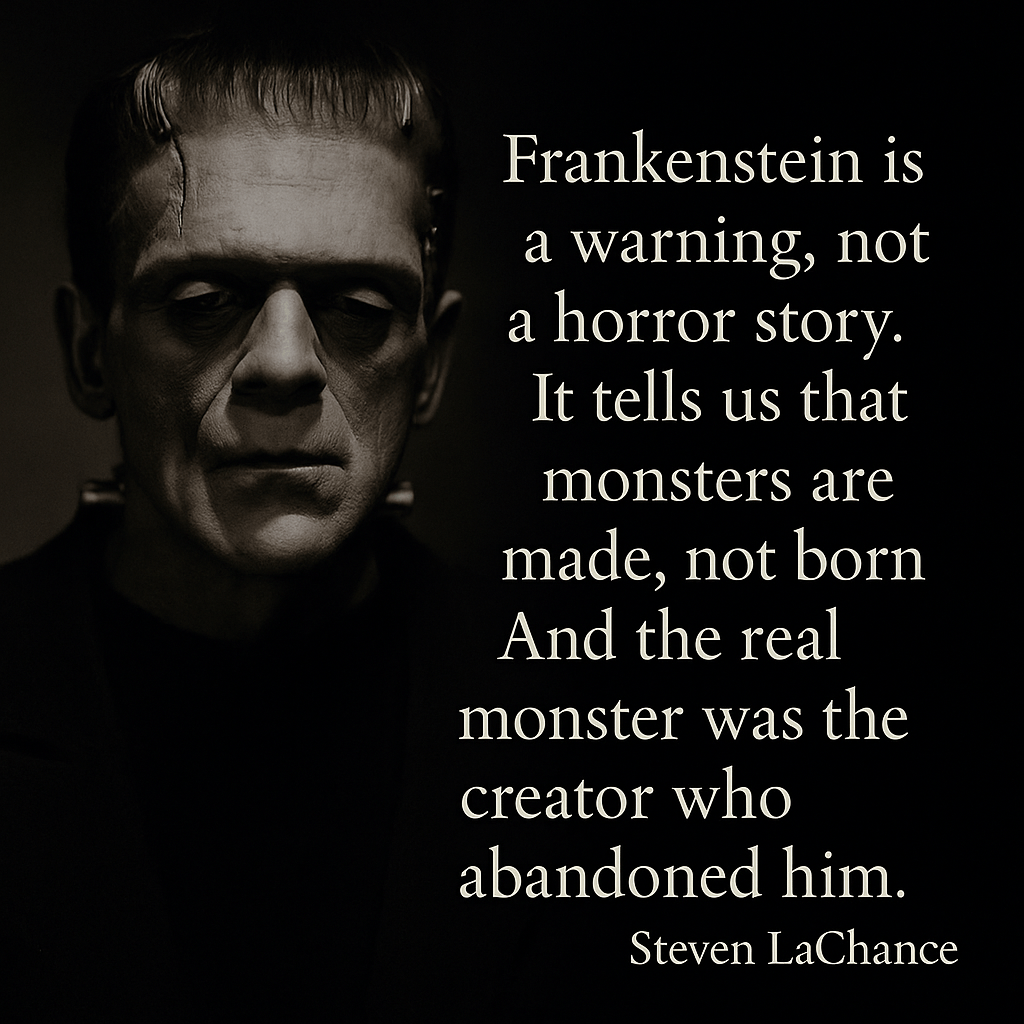
There is a case to be made that Frankenstein is not just a gothic novel or a cautionary tale about science, but also one of the earlier works of queer literature. Mary Shelley wrote it at nineteen, surrounded by the radical thinkers of her time, many of whom challenged the norms of love, gender, and identity. In this light, the creature becomes more than a symbol of scientific ambition gone wrong. He becomes an outsider, a being who is hated and hunted simply for existing.
The creature’s story reads like a queer narrative. He is born into a world that recoils at his very presence. His first impulse is not violence but love, a deep desire for connection. He learns language, reads poetry, and seeks out companionship, yet he is rejected at every turn. Even his own creator cannot look at him without horror. That rejection is at the heart of so many queer stories, both then and now: to be cast out by family, by society, by God himself, for something intrinsic to who you are.
There is also an undeniable intimacy between Victor and his creation. He pours himself into this act of creation with obsessive passion, fashioning a man from the pieces of other men. There is a strange, charged undercurrent here. Shelley may not have written it as overtly queer, but she understood what it meant to live outside traditional roles. Her circle, filled with scandal and unconventional relationships, challenged the moral boundaries of her time. In Frankenstein, she gives us a relationship that is almost too close, too intimate, and then makes it a source of horror. This is something queer readers have always understood: how easily society turns desire into monstrosity.
The creature himself becomes a mirror for the queer experience. He wanders the edges of society, watching the warmth of families he will never join, yearning for a love he is denied. He makes a simple plea to Victor: create someone like me. A companion. A partner. Not a lover in the traditional sense, but a being who would understand him, who would share his exile. Even this request is refused. Queer longing is often about more than romance; it is about belonging. Shelley’s monster speaks to that loneliness with devastating clarity.
Seen this way, Frankenstein is not just about scientific hubris or theological doubt. It is about the pain of being othered. It is about the violence of rejection and the way society creates monsters by refusing to see humanity in those who are different. Queer readers have always gravitated toward stories of monsters, not because they are villains but because they are reflections. In this novel, Shelley’s creature is not evil. He is brokenhearted.
Perhaps that is why Frankenstein endures. It is a story for anyone who has felt cast out, anyone who has been told that who they are is unworthy of love. The creature’s cry is not just the cry of science gone wrong. It is the cry of every soul who has been pushed to the margins and told they do not belong. Shelley may not have intended it as a queer novel, but that is the beauty of literature: sometimes stories tell truths the author could not name.
 Steven LaChance Blog
Leave a comment