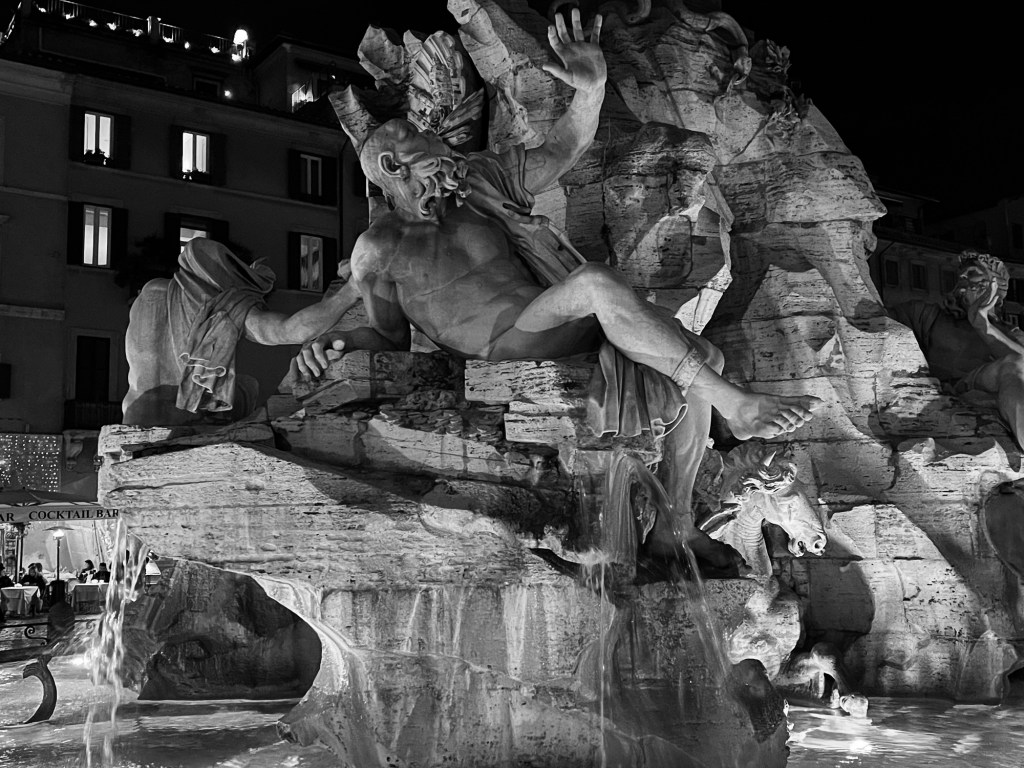
Rome, Italy (Photo, Steven LaChance)
A few years back, I found myself wandering through Rome’s enchanting Piazza Navona, completely captivated by its timeless beauty. I paused in front of Bernini’s famed fountain—one of those mesmerizing spots that just pulls you in. That’s when I first heard the local lore: couples who fail to circle the piazza in a strict clockwise direction are doomed to part ways within six months. It sounds absurd, but then again, this is Rome, where even the love stories come with a twist.
Yet, the allure of Piazza Navona isn’t confined to whimsical relationship rules. Tucked behind its stunning façade lies a ghost story that I couldn’t resist digging into. The tale centers on Donna Olimpia Maidalchini Pamphilj—though locals affectionately dubbed her “the Pimpaccia,” a nickname that evokes the scandal and intrigue of a bygone era. Born into modest beginnings, she married into a powerful family—one so influential that one of her husband’s brothers ascended to the papacy as Pope Innocent X.
From the grand palace overlooking Piazza Navona, Donna Olimpia reigned like a true queen. She skillfully navigated the treacherous waters of Roman high society, pulling political strings and even swaying the pope himself. If you wanted to make your mark in those elite circles, you had to court her favor—usually with lavish gifts and, of course, gold. But not everyone was enamored by her power; whispers even suggested she was the pope’s secret lover. Scandal, intrigue, and ambition all blended together into one unforgettable narrative.
Then, on January 7, 1655, the story took a dramatic turn. Mere hours before Pope Innocent X died, Donna Olimpia loaded two cases of gold coins onto a carriage and vanished from Rome without a trace. The new pope, Alexander VII, was none too pleased with her daring escape. He exiled her to a tiny town north of Rome—San Martino al Cimino—and demanded the return of the stolen gold. Naturally, she refused, and two years later, fate caught up with her when the plague struck.
As I later reflected on my stroll through those ancient Roman streets, the legend of Donna Olimpia took on an almost tangible presence. Every January 7, the tale is reborn: locals claim her spectral figure, still commanding that eerie black carriage laden with gold, dashes through the shadowed corridors from Piazza Navona toward Ponte Sisto, vanishing into the labyrinth of Trastevere. It’s as if Rome herself whispers reminders of the city’s turbulent past—an intoxicating blend of beauty, scandal, and mystery that lingers long after the night falls. Walking those cobblestones, you can’t help but feel that beneath every charming façade lies a secret waiting to be unveiled, urging you to look a little closer and listen a little harder.
 Steven LaChance Blog
Leave a comment