(This event took place while I was writing my book, Confrontation with Evil, which recounts the true story of the St. Louis exorcism case. Many strange occurrences happened during the writing of that book, and this was just one of them.)
As I wandered through the streets of downtown St. Louis, trying to clear my thoughts, I unexpectedly came across something that still unsettles me when I reflect on it today.
The air was thick with the city’s usual blend of exhaust, hot pavement, and distant grease from nearby cafes. But beneath it, something else lingered—something metallic, acrid, and wrong.
Then I saw him.
Crouched on the sidewalk in a tangle of dreadlocks, a man sat motionless, his head bowed as if engaged in a deep conversation with the concrete. His clothes were tattered, worn thin by time and the elements. He mumbled in low, rhythmic tones, his fingers tracing invisible patterns on the pavement, lips curling at the edges—as if he found something deeply amusing.
Then, as if he sensed my presence, he lifted his head.
His quiet murmuring twisted into a slow, deliberate chuckle, a joke only he understood. His eyes locked onto mine, and my breath hitched. They weren’t just dark; they were wrong—depthless, hungry. A blackness that didn’t reflect the light but swallowed it whole.
It wasn’t merely darkness or a fleeting sense of evil I thought I saw in them—it was something far more ominous. A knowing. A challenge.
He wasn’t lost or broken; he was aware.
And he was a threat.
Then I heard someone crying next to me. It was soft yet loud enough and sudden enough to catch my attention.
I turned to see an elderly woman sitting on a nearby bench, hunched over slightly and rocking back and forth. She appeared agitated and frazzled. I had seen the face of dementia before, and I immediately recognized it in her. Her frail hands twisted in her lap, and her face was etched with grief. She seemed lost within herself and frightened. She was sobbing softly when she noticed me; her red-rimmed eyes flickered between the man across the street and me, her mouth trembling. It was almost an unspoken way for her to convey that there was something to fear, as if to suggest with her eyes that we were both in danger.
“Help me.”
Her voice was hoarse and cracked, pleading.
I took a cautious step toward her. “Ma’am, are you okay?”
She didn’t respond, tears streaming down her face, her body trembling. She remained silent, trapped in an internal nightmare, overtaken by whatever had taken control of her thoughts. Those first two words were the only words she spoke to me, and then she seemingly retreated into a muted state as if someone had switched off her ability to communicate. Maybe in a brief moment, she had been able to break through her fog with a plea for help. Whatever the reason she remained in a state of frightened silence now.
The man’s laughter became louder from across the street as if to draw my attention away from the woman.
He stretched his arms upward, his shoulders trembling, his whole body convulsing with delight. The sound wasn’t just cruel—it was intentional. It drowned her out, crushing her beneath it.
And then I understood.
I wasn’t merely witnessing something dark; I was immersed in it. Caught between two forces—madness and malice—I felt out of place. I wasn’t meant to see this.
The air thickened, pressing against my chest. My pulse pounded in my ears, my body screaming for me to move.
I had to get away.
I stumbled back, breaking the spell. The world snapped back into focus—the distant honking of car horns, the chatter of pedestrians, and the familiar hum of the city. Everything felt the same, yet nothing seemed quite right. It was like emerging from the confusion of a nightmare as I hurried through the streets toward home.
I didn’t look back.
I called the police on my way home. There wasn’t much I could tell them because nothing physically obvious had happened. The only information I had to share was about an elderly woman sitting on a park bench asking for help. I never heard back from them, and I don’t know what they found when they arrived at the scene. Sometimes it’s better not to know. I’m not sure what disturbed me so deeply—only that something felt off, really off.
That night, I tried to shake off the encounter, but its weight clung to me, taking my thoughts hostage and refusing to let me go. I attempted to rationalize things in my mind, but the man’s face kept interfering with any justification I might have found. In that moment during the event when the city fell silent, it wasn’t just unease; it was a sense of displacement. I felt as though I had brushed against something that didn’t belong—or worse, something that did and had simply chosen that moment to reveal itself.
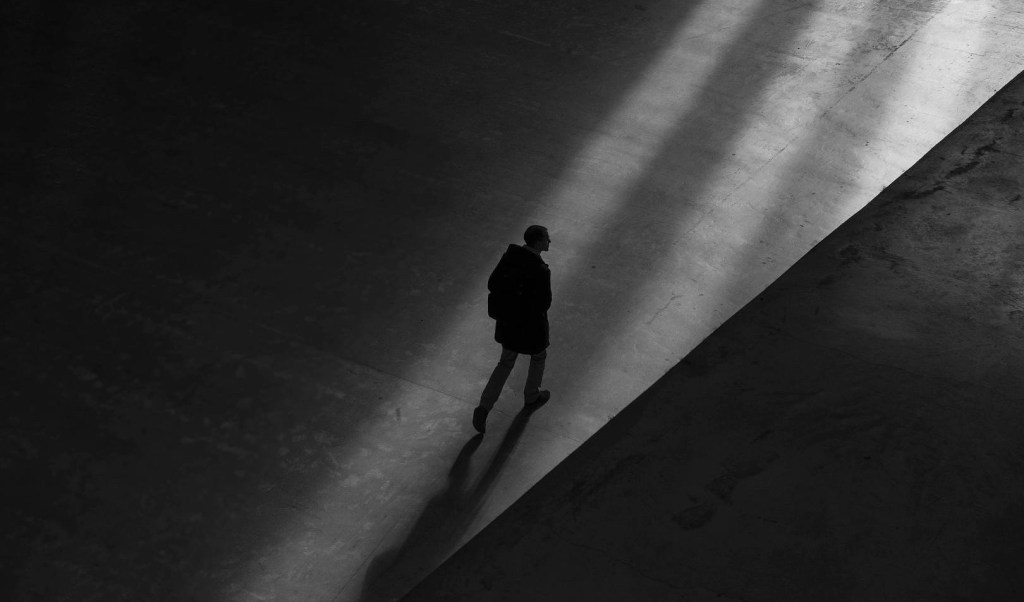
I sat in my dimly lit apartment, the glow of a single lamp casting long, fractured shadows against the walls. Music hummed softly from my speakers—Pink Floyd’s “Wish You Were Here.” A song I had heard a thousand times, but now, in the stillness, the lyrics resonated differently:
“So, so you think you can tell
Heaven from Hell? Blue skies from pain?
Can you tell a green field from a cold steel rail?
A smile from a veil? Do you think you can tell?”
It was no longer just a song; it had become a question—one I wasn’t sure I could answer. Could I still distinguish between heaven and hell, good and evil, or had I ventured so deep into the void of the unknown through all my research and work that I would be haunted by these thoughts for the rest of my life? It was a very real question and an even more pressing concern.
If you had asked me that morning whether I could tell the difference between a man lost to the streets and something else, I would have answered yes. Without hesitation.
Now, I wasn’t so sure.
Even in the safety of my apartment, I couldn’t shake the feeling of being watched by unseen eyes. It wasn’t paranoia or an overactive imagination; it was something more tangible. My skin prickled with the chill of cold air, and my muscles were tense, as if I had left a door open somewhere—one I hadn’t meant to.
They say the city is full of ghosts.
Not all of them are dead.
That night, as I lay in bed, I gazed at the shadows lurking in the corners of my room, fearing the evil laughter I prayed would never happen—and even more frightening, the man with dreadlocks might emerge from the darkness in the dead of the night. You understand the fears you attempt to set aside, hoping to lull your mind into sleep. I was looking for a comforting illusion of safety that never materialized.
I reached over and clung to my husband.
Even then, I did not feel safe.
Copyright 2025. Steven LaChance, All Rights Reserved.
 Steven LaChance Blog
Leave a comment