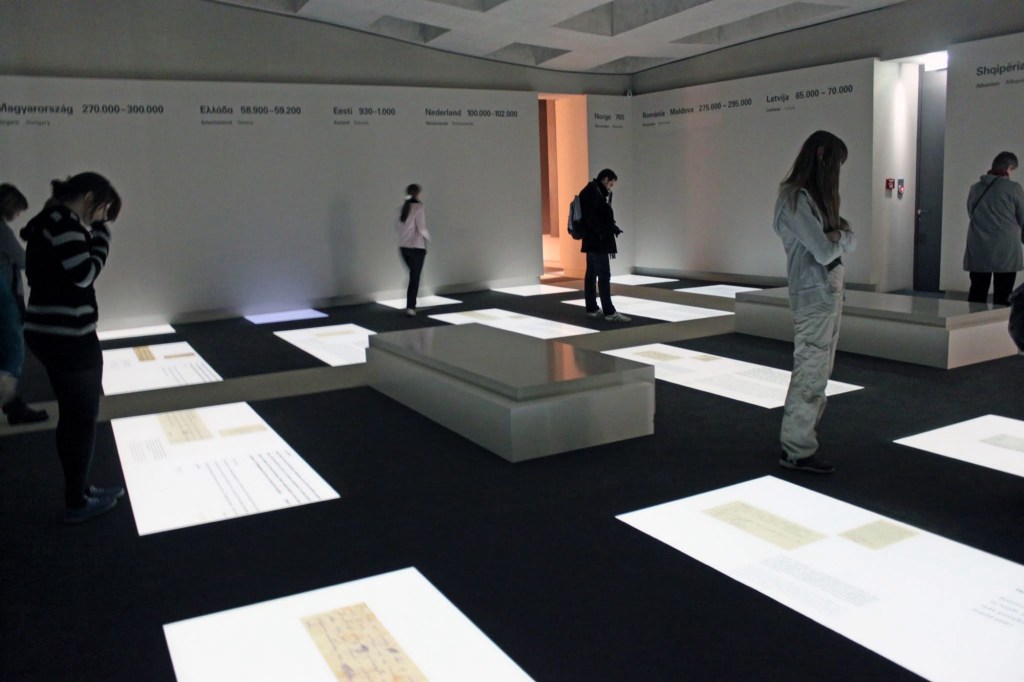
Imagine stepping into one of the rooms at the Memorial to the Murdered Jews of Europe in Berlin. The floor stretches out before you, a mosaic of words—fragments of diaries, letters, final cries etched into stone. You look down, as if standing over graves, and read the shattered pieces of lives swallowed by the Holocaust. Six million murdered. But here, the numbers dissolve into names, into voices. A mother’s last plea. A brother’s unfinished sentence. Each one feels like a hand reaching up from the earth, gripping your ankles, begging you not to look away.
The air feels heavy, suffocating. I remember reading once how the memorial’s stark concrete blocks, cold and grid-like, were designed to disorient—to echo the bureaucracy of genocide. The architect, Peter Eisenman, wanted visitors to feel the unease, the loss of humanity, that comes with such systematic destruction. But nothing prepares you for the intimacy of these words. I kept moving, trembling, until I froze at a single testimony. A child’s words. She couldn’t have been older than eight or nine. She wrote about praying to be dead before the Nazis threw her into the pit. She’d heard that there were other children who were tossed in alive, their terror swallowed by dirt. And all she wanted was to spare herself that agony. To die first. She wanted to be dead before her body was thrown into the pit.
I’ve read history books. I’ve seen the photos. I’ve read the stories of Auschwitz. But this? This broke me. This was a little girl bargaining with God over how she’d be murdered. The sheer, grotesque normality of her fear—like worrying about bedtime or monsters under the bed—except her monsters were real. They wore uniforms. They had quotas. And they turned Europe into a machine of death so efficient, so soulless, that a child’s worst nightmare wasn’t the dark. It was surviving the fall into the pit.
I stepped outside, shaking, the Berlin sun harsh and indifferent overhead. That’s the thing about hate—it starts small. A sneer. A law. A dehumanizing joke. But feed it enough silence, enough compliance, and it becomes a pit. It becomes a child calculating her own death to avoid something worse. The memorial isn’t just a reminder of what happened. It’s a mirror. It asks us what we’re willing to see—and what we’ll refuse to repeat.
I think about that little girl often. Her prayer, her plea, her fear, her unimaginable choice. And I think about how history doesn’t just live in books or monuments. It lives in us. In what we carry forward. In what we refuse to let happen again. The memorial doesn’t just honor the dead. It demands something of the living. And that’s why it hurts. That’s why it should.
 Steven LaChance Blog
Leave a comment