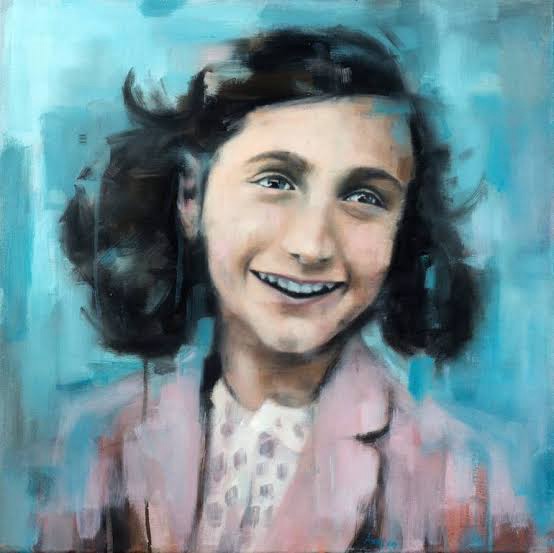
I often think of Anne Frank.
Her words, her story, her unwavering hope in the face of unimaginable fear have haunted and inspired me for as long as I can remember. But it wasn’t until I visited the Secret Annex in Amsterdam that I truly felt the weight of her presence.
Walking through those small, dimly lit rooms, I could almost hear the echoes of whispered conversations, the creaking of floorboards as the occupants moved cautiously, the scribbling of Anne’s pen against paper. It is a place frozen in time, yet heavy with history. The walls still seem to carry her dreams, her fears, and her endless curiosity about the world beyond those concealed windows.
I left a part of myself there.
Standing in that space, I could feel not only Anne’s energy but also Peter’s—the quiet boy she came to know so well within those walls. Their youth, stolen by war, still lingers in the air. It’s impossible to walk away from that place unchanged. The Annex is haunted, not in the traditional sense, but by memory, by the weight of lives interrupted, by the echoes of a girl who believed in the goodness of people even as the world around her crumbled.
I looked upward, toward the attic.
That small, secret space where Anne would steal glances at the outside world, where she would dream of freedom, where she and Peter shared whispered conversations and the tentative beginnings of young love. And despite everything, in that moment, I felt happiness. It struck me that even in the darkest of times, happiness, even in the smallest moments, can find a way. Maybe it was the memory of Anne and Peter finding light in each other, or maybe it was a deeper truth—no matter the circumstances, the human spirit reaches for joy.
I walked downstairs into the lower floor of the museum, where the glass cases hold relics of her short but extraordinary life. And then, in a spot-lit case, I saw it—the original diary. The little red-and-white checkered book that has given a voice to the voiceless, that has ensured Anne’s words would never be silenced.
I began to cry.
The rush of emotion surprised me. It was overwhelming—grief, awe, sorrow, admiration—all tangled together. Standing before that diary, I wasn’t just looking at ink on pages. I was looking at a life. A life that should have been longer. A life that, despite everything, still reaches across time to touch hearts, to remind us of the power of words, of truth, of resilience.
And I wonder—what would Anne think of the current state of the world? Would she be disappointed in us? She believed in the goodness of people, even as the worst of humanity hunted her and her family. Would she still believe it now? Or would she look at our wars, our divisions, our cruelty to one another, and feel disillusioned?
I think, too, of her father, Otto Frank. The only one from the Annex who survived. He went to the train station every day after the war, searching for Anne and Margot, desperate for news, until he finally learned that both of his daughters had died in Bergen-Belsen. I can’t imagine his grief—the heartbreak of holding on to hope, only to have it shattered.
But the thing that has always stuck with me about Otto’s reflections on Anne is what he said after reading her diary: “I never really knew my daughter.” He was astonished by the depth of her thoughts, the complexity of her emotions. And I suppose that’s the truth for all parents. No matter how much they love their children, they never truly know them—not in the way their children know themselves.
Anne Frank’s life was stolen from her, but her words live on. They remind us of who we are and who we should strive to be. And maybe, just maybe, if we listen closely enough, we can still prove her right—that despite everything, people are truly good at heart.
 Steven LaChance Blog
Leave a comment