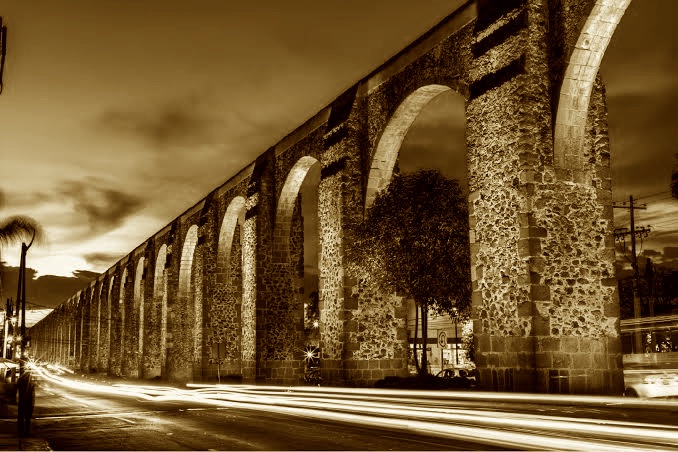
Acueducto de Querétaro
Let me take you on a brief journey through the fascinating history of Querétaro, a city whose story spans from its colonial beginnings to its current status as a thriving metropolis.
It began in 1534 when D. Juan Sánchez de Alaníz designed the city’s layout. Just a few years later, in 1540, the Great Convent of San Francisco, the city’s first religious structure, was built, sponsored by Fernando de Tapia, also known as the Otomi Conín.
Over the centuries, Querétaro flourished. By the 17th century, the blending of rural and urban life spurred the construction of numerous temples and convents as various religious orders established their presence. In 1656, the Villa of Querétaro earned the prestigious title “Noble and Loyal City of Santiago de Querétaro,” an honor later confirmed by King Philip V in 1712.
The 18th century ushered in an economic boom. Livestock, agriculture, and textiles—Querétaro even became North America’s leading wool producer—fueled the city’s prosperity. The Royal Tobacco Factory became the second most important in New Spain, and the clergy reinvested in Querétaro, building lavish temples and monasteries that still impress today. Iconic structures like the aqueduct, begun in 1726, and the Cathedral, completed in 1763, helped define the city’s elegant urban landscape.
The 19th century brought a spirit of change. Amid political instability and foreign invasions, Querétaro became a hotbed of revolutionary ideas. Conspiracies brewed here, leading to the arrests of key figures like Epigmenio González and the notable couple, Miguel Domínguez and Josefa Ortiz de Domínguez. This courageous stance earned Querétaro the moniker “cradle of Mexican independence.”
Following the turbulence of the War of Independence, Querétaro faced further challenges. In 1847, during the American invasion, the city briefly served as the capital of the Republic. The French invasion in the 1860s and the subsequent fall of Emperor Maximilian in 1867 further shaped its destiny. The ensuing reforms dramatically altered Querétaro’s landscape, repurposing temples and transforming sacred spaces into public venues.
The 20th century saw Querétaro embrace modern advancements. Schools proliferated, vaccination campaigns began, urban transport improved, and industry took off. In 1916, it again served as the nation’s capital when Venustiano Carranza convened the assembly that drafted the new national constitution—a landmark moment in Mexican history. Querétaro’s modern transformation accelerated between the 1940s and 1960s, its urban area expanding by over 400% in just a few decades.
Today, Querétaro’s historic charm, particularly its cobblestone streets and colonial buildings, has earned it a UNESCO World Heritage Site designation (1996). That same year, the city reclaimed its original name, Santiago de Querétaro.
This rich tapestry of history makes Querétaro more than just a place to visit; it’s a living story that continues to unfold.
 Steven LaChance Blog
Leave a comment