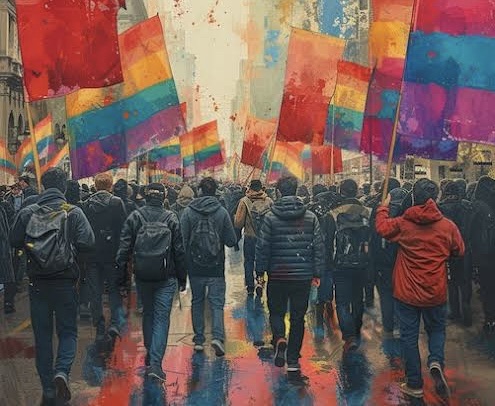
History isn’t just a collection of dusty stories—it’s a battlefield where queer voices have always fought for their right to be heard. Today, in the United States, forces are trying to shove these voices back into the closet: banning books, erasing queer history, and silencing those who dare to remember and resist.
Imagine the blazing deserts of ancient Persia, where Alexander the Great rode with Hephaestion, his comrade in war and in love. Their bond was a fierce declaration of loyalty and desire, a love so incendiary that it refused to be hidden. When Hephaestion died, Alexander’s grief transformed an empire—draping it in mourning and erecting altars for a love that defied silence.
Fast forward to the 20th century, when Alan Turing cracked codes that saved millions. Society, narrow-minded and brutal, punished him for loving men. They attempted to erase him, yet his legacy now pulses through every algorithm in our digital age—a stark reminder that brilliance thrives even under oppression.
Then there’s Frida Kahlo, who bared her pain and passion on canvas as a proud bisexual woman defying the limits imposed on her. And Oscar Wilde, whose searing wit and forbidden love letters to Lord Alfred Douglas became an act of rebellion in a repressive era. His words, “the love that dare not speak its name,” now resonate like a rallying cry against censorship.
The summer of 1969 was a turning point. At the Stonewall Inn, Marsha P. Johnson, crowned in flowers and fury, tossed a shot glass that shattered silence. Alongside Sylvia Rivera, she tore down the walls of repression, declaring, “We ain’t gonna live in the shadows no more.” Their defiance ignited a revolution that continues to blaze against efforts to erase their legacy.
Across the ocean, Josephine Baker swayed in a banana skirt, her laughter a potent act of defiance. More than an entertainer, she was a spy, a mother of a “Rainbow Tribe,” and a warrior who refused to sing for segregated crowds. Her life—a blend of glamour and grit—reminds us that audacity can bend the arc of justice.
Consider the quiet yet relentless heroes: Bayard Rustin, the gay architect of the March on Washington, whose steady hand guided a movement despite attempts to silence him, and Sally Ride, who soared into space while her true love remained hidden, a secret locked away by fear. Their stories scream the truth: queer lives have always been here, stitching resilience into the very fabric of history.
For queer youth, this legacy isn’t a relic to be forgotten—it’s a battle cry. In a country that now seeks to hide queer narratives behind locked doors and banned books, these stories are your inheritance. They tell you, “You have always belonged here. We fought, we loved, and we defied so that you could stand tall.” They are both your roots and your wings—a foundation of strength and a call to shape the future on your own terms.
When you learn that Alan Turing’s genius outlived his persecutors or that Frida Kahlo turned agony into art that still burns brightly, know that you’re holding a blueprint for survival—and thrival. In these times of censorship, reclaiming queer history is an act of fierce resistance. It’s a declaration that no one can mute your voice or erase your story.
Queer history is not a quiet chronicle of the past—it’s a blazing torch passed hand to hand across millennia. It shouts to every lonely child, every questioning teen, every isolated dreamer: You are the latest verse in an epic poem of defiance. Your love, your anger, your joy—they will ripple forward and shatter the silence.
So let’s grab that torch and march on. We will not allow our stories to be hidden or erased. We will write, revise, and reclaim our history—one radiant, rebellious heart at a time.
 Steven LaChance Blog
Leave a comment